What's new

Global Warming

My point is just f people being more conscious of their own consumption if they believe in global warming, not large scale governmental projects.
Yep and this is what I was saying as well.
 
Watched the video, and I can't say I find those rebuttals of climate change all that impressive.

1. Temperature has changed only 0.8 degrees in 100 years. That's not much.

So +0.8K in 100 years is MASSIVE. His argument seems to be partly based around the fact that the number 0.8 sounds small, which I find incredible. Average global temperature has changed by only 0.5 degrees since the end of the last ice age!


Holocene_Temperature_Variations.png

The last ice age ended just 12,000 years ago. You accuse him of using meaningless numbers that appear smaller than they truly are, then use meaningless numbers with ! that appear larger than they truly are. What's less, .8 out of 100 degrees or 12,000 years out of 5 billion?


This is an unprecedented change in Earth's history. Also a change in CO2 concentration of ~50ppm is huge. It has risen by around 30% in just 150 years. Think of that. We've dumped enough CO2 to change an amount of CO2 that had been stable for MILLIONS of years by 30%.


co2_temperature_historical.png

This graphic shows CO2 rising from an all time minimum. What's the alarm? Life has evolved just fine with higher levels. Who's to say sequestering carbon for billions of years hasn't had an adverse impact on life?


--------


It's too bad our bible thumping, alarmist, dystopian future indoctrinated society can only seek to find the negative effects of every and anything. For every downside to global warming/cooling/revolvingaroundthesun there are going to be 10x more benefits because that's the beauty of life. It's too bad all the research money behind this is pumped into making careers on the detrimental side instead of the other. Big business and all of that...
 
Watched the video, and I can't say I find those rebuttals of climate change all that impressive.

1. Temperature has changed only 0.8 degrees in 100 years. That's not much.

So +0.8K in 100 years is MASSIVE. His argument seems to be partly based around the fact that the number 0.8 sounds small, which I find incredible. Average global temperature has changed by only 0.5 degrees since the end of the last ice age!


Holocene_Temperature_Variations.png


This is an unprecedented change in Earth's history. Also a change in CO2 concentration of ~50ppm is huge. It has risen by around 30% in just 150 years. Think of that. We've dumped enough CO2 to change an amount of CO2 that had been stable for MILLIONS of years by 30%.


co2_temperature_historical.png


See that tiny steep rise at the very end of the CO2 curve? See how it's preceded by several million years of absolute flatness? It is a logarithmic scale, so we've increased the levels in 100 years to match those of 5 million years ago. It is the largest slope on the curve, despite the fact that as you go further back in time, time gets more and more compressed on the graph.


2. You can't even measure such small variations in average temperature!

Of course you can. Below is a link that shows that increase in average temperature pops up regardless of the method used. I'm gonna ignore the fact that if you really didn't think global temperature can be measured, you wouldn't have bothered dismissing the smallness of 0.8K.

https://www.skepticalscience.com/surface-temperature-measurements-advanced.htm

From the page, here's the graph that shows LAND ONLY temps, since he suggested a conspiratorial reason for the fact that ocean temperature is now used along with land temp to calculate averages. You know, instead of the fact that the ocean covers most of the Earth and plays a huge role in governing the climate.


Land-only-temps.png


3. And who is to say what is optimal anyway?

There is no such thing as optimal. There is only the incidental conditions that we find ourselves in. Those are the conditions that the current biosphere finds itself in, and the one humans built their civilization around. Had we lived in the Triassic, sea level would have been hundreds of feet above current levels, and we would have strove to keep it that way. What matters is that changes that used to take millions of years to occur are now happening over decades due to human activity. There is no way evolutionary mechanisms are capable of adapting to such rapid changes, and global climate change will undoubtedly cause a mass extinction event.

Human civilization has also been built around current conditions. Changing climate means some previously fertile areas will no longer be commercially viable. Previously habitable areas will be submerged. Any change in ocean current would have SERIOUS effects on global weather, and would disrupt the lives of billions. Compare the difference in climate between Alaska and Norway (similar latitude, different ocean current). What is Scandinavia suddenly shifts to the barely livable Alaskan climate?

It would also mean, of course, that some areas will become more fertile, and other areas will become prime ocean-front real estate. But adapting to this new reality will be costly.


4. Even though temperature has risen over the past 100 years, life is better than ever.

Not really relevant. The Earth has a certain capacity to "absorb" the immediate effects of rapid change, but we know for a fact that conditions throughout Earth's history had been very different than conditions today. Our current conditions are "optimal" for us since we evolved around them. Any change will come with an environmental and human cost.

I don't want to spend my night debating climate change, but there are vast number of resources on the internet for those seeking an education on the subject. And the science shows that the temperature is increasing, that it is increasing due to human activities, and that there will be consequences to the increase.

The debate should not be about whether the planet is warming. We already know it is. It should be about the extent to which it is warming, the precise mechanisms causing and mitigating the change in climate, the period over which the changes will unfold, the details of this unfolding, and the best ways to tackle the effects of climate change in the short and long run.
Thanks Siro, your post is very helpful, at least to me. There is so much hyperbole in conversations on this topic (from both sides). It's refreshing to hear a scientific viewpoint. I have a couple of questions:

1) I don't understand your first graph. Can you help me read it? Specifically, how does it show what you're saying it shows?

2)The second graph and your explanations are excellent. The CO2 increase is the one part of the GW argument that I'm able to understand. I have no doubt that CO2 is increasing, but I'm unsure if it's impacting the environment (both sort term and long term) in the way the GW is claiming that it is. I wish I understood the blue delta temperature line better.

3) Your third graph is helpful in showing the current temperature trend is rising (though it does not confirm political rhetoric that last year was the hottest ever). Similar data was shown on the video, then he presented a wider view which showed that this was not a 30 year trend, but rather a 300 year trend. I'm also curious to know what would account for the wide seasonal fluctuations in the data. Presumably they are measuring temperatures in all parts of the earth, so hot summer temps in the northern hemisphere should be counterbalanced by simultaneous cold temperatures in the southern hemisphere and vice-versa. I have become skeptical of the data in the course of my investigation into this matter because there have been admitted cases of tampering, so I just want to determine if it's reliable.

Another source of my skepticism is personal experience. For example, my dad makes an ice rink in his back yard every year, and has for over 40 years. Some years it works out well, other years it melts before we can do much skating. If the world was consistently warming it seems like I would look back to my childhood and recall rinks that were significantly better than what we've had recently. The ability to build a good ice rink would be decreasing, but that hasn't been the case. His best rink ever was three years ago. Last years rink was also very good. I remember the first time we ever skated as late as SuperBowl Sunday. We were amazed the rink had lasted so long. Nowadays we often skate well after the SuperBowl. If the climate really is warming so rapidly, wouldn't you think that the ability to maintain a sheet of ice in the back yard would be negatively effected?
 
The last ice age ended just 12,000 years ago. You accuse him of using meaningless numbers that appear smaller than they truly are, then use meaningless numbers with ! that appear larger than they truly are. What's less, .8 out of 100 degrees or 12,000 years out of 5 billion?


This graphic shows CO2 rising from an all time minimum. What's the alarm? Life has evolved just fine with higher levels. Who's to say sequestering carbon for billions of years hasn't had an adverse impact on life?


--------


It's too bad our bible thumping, alarmist, dystopian future indoctrinated society can only seek to find the negative effects of every and anything. For every downside to global warming/cooling/revolvingaroundthesun there are going to be 10x more benefits because that's the beauty of life. It's too bad all the research money behind this is pumped into making careers on the detrimental side instead of the other. Big business and all of that...

Okay, so we're not talking about whether life will ultimately prevail or not. Of course it will. What I care about are the effects of climate change on the lives of actual humans, and on the rest of the biosphere after that. Consequently, anthropocentric concerns are pivotal to the discussion. Who gives a **** about what life was like 4 billion years ago? I would think that if the atmosphere was to revert back to its original oxygen-free state, we'd be in deep trouble, regardless of the bright side. Anaerobic bacteria be damned!

Consequently, 12000 years is a more significant number than 4 billion, despite the fact that the latter is bigger. That is because humans built their civilization during this period, around current conditions. A large percentage of the human population inhabit coastal areas and will have to contend with a rising sea level. Many of the systems, man-made and natural, that we depend on are based around specific climates and will have to be adjusted/moved at a great economic cost.

And there is also the issue that non-human animals are very vulnerable to climate conditions, and require a long time to adjust. Unlike humans, they can't just shape their environment to their liking. They depend on the painfully slow processes of natural selection. And the Anthropocene waits for nobody!

Yes, the alarmist side is absurd. But your "don't worry about it, I'm sure things will be fine" mentality isn't very helpful. If there is a problem, we try to understand it, and figure out paths to a better outcome. End of story.
 
  • Like
Reactions: GVC
Thanks Siro, your post is very helpful, at least to me. There is so much hyperbole in conversations on this topic (from both sides). It's refreshing to hear a scientific viewpoint. I have a couple of questions:

1) I don't understand your first graph. Can you help me read it? Specifically, how does it show what you're saying it shows?

The different colored lines are different locations. Usually tropical temperatures fluctuate less than polar ones. Some areas also experience massive changes in climate compared to others over relatively short period, like the Sahara. But the black line shows the average of all locations (so average Earth temp). As you can see, the average has actually varied very little since we entered this era. So 0.8 degrees increase is not just a small statistical aberration. It is a large increase.

3) Your third graph is helpful in showing the current temperature trend is rising (though it does not confirm political rhetoric that last year was the hottest ever). Similar data was shown on the video, then he presented a wider view which showed that this was not a 30 year trend, but rather a 300 year trend. I'm also curious to know what would account for the wide seasonal fluctuations in the data. Presumably they are measuring temperatures in all parts of the earth, so hot summer temps in the northern hemisphere should be counterbalanced by simultaneous cold temperatures in the southern hemisphere and vice-versa. I have become skeptical of the data in the course of my investigation into this matter because there have been admitted cases of tampering, so I just want to determine if it's reliable.

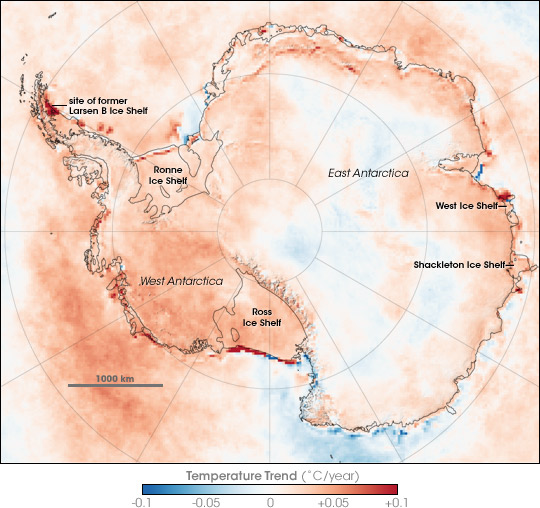
So it's not true that Antarctica is cooling. It is warming just like the rest of the planet. There are always regional, seasonal, and annual variation in temperatures, but the warming trend is unmistakable. And it's also not true that we only have "8 thermometers" in Antarctica. In addition to the ~20 weather stations, we have continuous satellite observation of the continent (however, it is often cloudy there, which affects quality of the observations).

Here's what the data from satellites show over the past 30 years since we started observing:

Antarctic_Temperature_Trend_1981-2007.jpg


Another source of my skepticism is personal experience. For example, my dad makes an ice rink in his back yard every year, and has for over 40 years. Some years it works out well, other years it melts before we can do much skating. If the world was consistently warming it seems like I would look back to my childhood and recall rinks that were significantly better than what we've had recently. The ability to build a good ice rink would be decreasing, but that hasn't been the case. His best rink ever was three years ago. Last years rink was also very good. I remember the first time we ever skated as late as SuperBowl Sunday. We were amazed the rink had lasted so long. Nowadays we often skate well after the SuperBowl. If the climate really is warming so rapidly, wouldn't you think that the ability to maintain a sheet of ice in the back yard would be negatively effected?

We're at no risk of turning into Venus. It is just a small amount of warming. We'll still have ice rinks even when temp reaches its maximum. The problem is the emergent properties of small changes in a complex system. A difference of 1 degree can mean a change in the direction of an ocean current, making a continent like Europe several degrees colder, while empty Kamchatka warms a few degrees. Sure people from Europe can move to Kamchatka, but then they'd have to contend with Putin, who's a douche.
 
Yes, the alarmist side is absurd.
I appreciate you saying this because it is that alarmist message that I'm reacting negatively to. I am in favor of reacting in reasonable ways to the truth, but I am insulted when disinformation is disseminated in order to try to get me to respond with more urgency. I am definitely not in the fishonjazz/cy camp who think it's a good thing for science to cry wolf.
The different colored lines are different locations. Usually tropical temperatures fluctuate less than polar ones. Some areas also experience massive changes in climate compared to others over relatively short period, like the Sahara. But the black line shows the average of all locations (so average Earth temp). As you can see, the average has actually varied very little since we entered this era. So 0.8 degrees increase is not just a small statistical aberration. It is a large increase.
But the black line doesn't lead to a historic high, or anything close to it. It appears to be fluctuating in a range that it's been fluctuating in for some time. I don't see the 0.8 degree jump. How am I missing it?


So it's not true that Antarctica is cooling. It is warming just like the rest of the planet. There are always regional, seasonal, and annual variation in temperatures, but the warming trend is unmistakable. And it's also not true that we only have "8 thermometers" in Antarctica. In addition to the ~20 weather stations, we have continuous satellite observation of the continent (however, it is often cloudy there, which affects quality of the observations).

Here's what the data from satellites show over the past 30 years since we started observing:

Antarctic_Temperature_Trend_1981-2007.jpg


We're at no risk of turning into Venus. It is just a small amount of warming. We'll still have ice rinks even when temp reaches its maximum. The problem is the emergent properties of small changes in a complex system. A difference of 1 degree can mean a change in the direction of an ocean current, making a continent like Europe several degrees colder, while empty Kamchatka warms a few degrees. Sure people from Europe can move to Kamchatka, but then they'd have to contend with Putin, who's a douche.
Good explanation. Maybe it's worth panicking now that you point out the Putin factor. He's even worse than Hillary would be.
 
But the black line doesn't lead to a historic high, or anything close to it. It appears to be fluctuating in a range that it's been fluctuating in for some time. I don't see the 0.8 degree jump. How am I missing it?

That graph shows long term trends, and has a resolution of only 300 years. It shows the stability of temperatures over an entire era.

Here's the Wikipedia page that explains the graph and shows others of much better resolution covering smaller periods.

https://commons.wikimedia.org/wiki/File:Holocene_Temperature_Variations.png
 
That graph shows long term trends, and has a resolution of only 300 years. It shows the stability of temperatures over an entire era.

Here's the Wikipedia page that explains the graph and shows others of much better resolution covering smaller periods.

https://commons.wikimedia.org/wiki/File:Holocene_Temperature_Variations.png
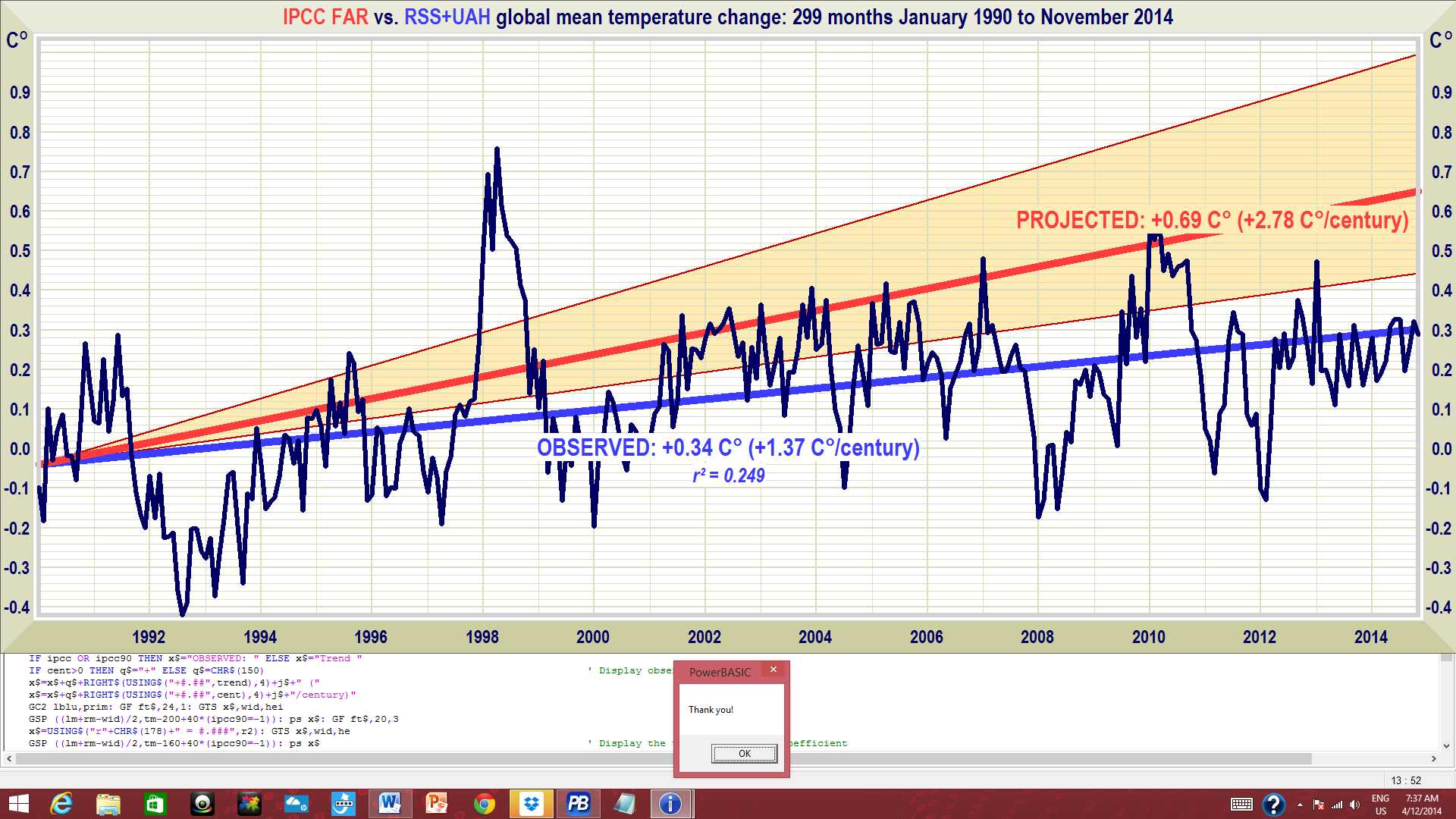
Thanks for the link. The information on that page shows me that temperatures were going up as of ten years ago, but the data collected since that time (which is not available on that page) shows me that the trend has not continued. Here is a graph of the last 25 years showing what was projected v.s. what has occurred:
Monckton-jan-2014-2.png

If you were to use that data to draw a trend line for the last ten years it looks like it would be flat (or very close to it). Yet Obama has told us that the problem is more urgent than ever, and that 2014 was the hottest ever. Why are so many people okay with this even though the data does not appear to support his claims?

The temperature trend is nowhere near what the GW alarmists told us it was going to be 25 years ago, but this good news not only seems to have no impact on the delivery of their message, they seem to be more adamant than ever that we are in imminent danger. Anyone who questions it is ridiculed. Why is this? It seems to me that the Al Gore crowd has hijacked this movement for political purposes. I wish the scientific community would divorce themselves from the alarmist hyperbole, but instead they seem to be embracing it. What is going on here?
 
Thanks for the link. The information on that page shows me that temperatures were going up as of ten years ago, but the data collected since that time (which is not available on that page) shows me that the trend has not continued. Here is a graph of the last 25 years showing what was projected v.s. what has occurred:
Monckton-jan-2014-2.png

If you were to use that data to draw a trend line for the last ten years it looks like it would be flat (or very close to it). Yet Obama has told us that the problem is more urgent than ever, and that 2014 was the hottest ever. Why are so many people okay with this even though the data does not appear to support his claims?

The temperature trend is nowhere near what the GW alarmists told us it was going to be 25 years ago, but this good news not only seems to have no impact on the delivery of their message, they seem to be more adamant than ever that we are in imminent danger. Anyone who questions it is ridiculed. Why is this? It seems to me that the Al Gore crowd has hijacked this movement for political purposes. I wish the scientific community would divorce themselves from the alarmist hyperbole, but instead they seem to be embracing it. What is going on here?

You showed a graph that clearly indicates that temperatures are rising, yet you continue to question climate change?

There is a lot of merit to what the alarmists are saying. They could prpbably go about it in a better way, but what they are saying is real.

Sea levels are rising. Levees are super costly, and moving entire cities is even more costly. This stuff is already happening in places like new Orleans and new york. The cost of the storms we experience on a more regular basis than the past is crippling the economy in these places. New Orleans is shattered. New Jersey and new york had billions of damage and some loss of life from a storm more recently. The storm that hit Puerto vallarta recently was purportedly the largest storm on record. How is that not alarming?

Locally, our water supply is dwindling and affecting the growth of consumables like produce and cattle. If you don't believe it, ask literally anyone in Nevada and California. Utah is somewhat insulated as the population base does not rely solely on the water in the Colorado River basin. Look at flaming gorge, lake Powell and lake mead. They might not ever be full again. How will the west support a growing population with a decreased water supply? Likely at a much greater cost or a reduced quality of life.

I get that the alarmists sound like tomorrow the world is going to end, but the reality is that the changes that are occurring are extremely costly already, and the cost in monetary and human value will continue to rise. It will nit be tomorrow, but our grandkids will have a very different world to live in.
 
If you think about climate change only in a fiscally conservative sense, that alone should be enough to Institute changes. Fiscal conservatives are super worried about the national debt we are leaving our children, but climate change will likely end up being far more costly than anything we have seen if we don't prolong the change and give ourselves time to adapt.
 
If you are committed to believing that temperatures are rising then don't click on this link:
https://www.forbes.com/sites/jamest...-not-u-s-temperatures-set-a-record-this-year/

A link that references US temperatures (not global temperatures) over and over again, saying both that they are not rising as measured and that the people who measure the US temperatures as not rising say that US temperatures as rising. This is just sad, really.

My explanation is that neither you nor the author of the paper care to discuss the actual science of global warming, and have to resort to a denialist side-show.
 
You showed a graph that clearly indicates that temperatures are rising, yet you continue to question climate change?

There is a lot of merit to what the alarmists are saying. They could prpbably go about it in a better way, but what they are saying is real.

Sea levels are rising. Levees are super costly, and moving entire cities is even more costly. This stuff is already happening in places like new Orleans and new york. The cost of the storms we experience on a more regular basis than the past is crippling the economy in these places. New Orleans is shattered. New Jersey and new york had billions of damage and some loss of life from a storm more recently. The storm that hit Puerto vallarta recently was purportedly the largest storm on record. How is that not alarming?

Locally, our water supply is dwindling and affecting the growth of consumables like produce and cattle. If you don't believe it, ask literally anyone in Nevada and California. Utah is somewhat insulated as the population base does not rely solely on the water in the Colorado River basin. Look at flaming gorge, lake Powell and lake mead. They might not ever be full again. How will the west support a growing population with a decreased water supply? Likely at a much greater cost or a reduced quality of life.

I get that the alarmists sound like tomorrow the world is going to end, but the reality is that the changes that are occurring are extremely costly already, and the cost in monetary and human value will continue to rise. It will nit be tomorrow, but our grandkids will have a very different world to live in.
My understanding is that New Orleans is below sea level primarily because the land is sinking, not because the sea is rising. I was not aware that either Puerto Vallarta or New York are being overwhelmed by rising seas. There has always been a consequence to being on the coast when a hurricane hits, though.

The graph I showed indicates a rise in temperature followed by temperature stability (although a decade is not long enough to know where we are headed long term). No matter what the situation is, though, it is my contention that we are better served by being told the truth, not by hyperbole. I might be a voice in the wilderness on this right now, but in the long run I'm confident that many people will realize it is counterproductive not to tell the truth. Lies always have negative repercussions.

2014 was not the hottest year on record. Saying that was in order to advance a political agenda is wrong.
 
Back
Top