What's new

OKC as a blueprint

Over the past decade or more, I've often expressed frustration with the utilization of recency bias in terms of having a template on winning, where we look at whoever last won the championship, employing a survival bias, and declare that to be the new and/or only formula for winning in "today's NBA." I do understand that you're drawing upon some similarities between the franchises that are relevant so I'm not 100% specifically stating this directed at you but more the larger context. Formulas don't work until they do. Winning a championship is such a rare event (one per year, and only ten in a decade) that the sample size is really difficult to extrapolate in terms of what works and what doesn't but we like to speak very definitively on what does or doesn't work for building a true contender. The reality, in my view, and the only pathway forward for any franchise, is to play the hand you're dealt as best as possible. Sometimes you get a good hand and sometimes you don't, but you have to play it, and only by playing it as best as possible do you put yourself in a situation to come out on top (and therefore become the new "model" for everyone else). Don’t pretend your hand needs to be like others’. If someone dropped a 10 and a 6, you don’t have to also because they have different cards, and likewise you don’t need to hold a jack or a 3 because that’s what someone else (or even everyone) did — again you’re holding different hands.

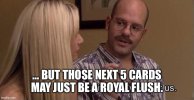
And I guess to beat a dead horse that's almost nearly killed a multi-decade intense fanship for me, but we had the best hand we've had in 25 years and decided to draw 5 new cards because our hand didn't look like the other hands people were holding. So we'll sit on the sidelines until we draw a royal flush. But, back to the survival bias, every team has flaws that can be exposed. Because there has to be a winner each year, it appears like those flaws weren't exposed. I think we're chasing a hypothetical where we're going to have some structure that we can move forward with in confidence without the perceived flaws. It's so much easier to have little expectation and I think there were legitimate beliefs about a championship happening after we'd been chasing it so long that being burned in the fashion we were with the previous iteration of this franchise. That has us very afraid of being vulnerable again without having great more security to allow ourselves to get to that point by hoping for a hypothetical team without perceived flaws (or as significant of flaws). It's much less emotionally painful to sit at the bottom with hypothetical assets and dream of all the ways it could be amazing if everything bloomed just right, in season, and without exposure to wind, hail, frost or storms. We balked at the idea of expending even one more asset on the last iteration of the team, as we could possibly ruin this team’s competitiveness for up to a decade taking that approach. Well, here’s the pathway we’ve opted for, three years later, looking at another tanking year, and being a contender in a best-case-scenario looks a lot closer to that ten year mark that we were somehow destined to jeopardize if we didn’t blow it all up…

But now our best bet, since dropping all five cards, is that we somehow hope like hell that we can draw a fresh hand that lands us something in the ball park of four of a kind or a full house. You know, kinda like the hand we just dropped. If we’re lucky.
1754712835649.jpeg
 
Unfortunately I don’t think there is a blue print, especially for a small market team that doesn’t attract free agents. OKC is great largely because of SGA and no one could’ve predicted how good he’d be. You have to get lucky in the draft and hope that player doesn’t leave.
A lot of teams were shocked when the Clippers traded SGA. He was already looking very promising at the time. I dont think they projected he would be this good but he was a very promising player when he was traded.

Also, OKC flipped players that weren't good enough quickly. I think that was a key to their success. They evaluated talent that they had quickly and didnt hesitate to say no to even first round draft picks when it wasn't right.
 
We are on year 3 with Keyonte knowing he is not a 2 way player. OKC would have already flipped him and given Dort a chance.
Who are all these first-rounders (meaning guaranteed contracts) that OKC abandoned before year 3. Let's go back a decade and look at first round picks that the Thunder didn't hold onto.

Josh Huestis? 3 years. Cameron Payne? 3 years. Terrance Ferguson? 3 years. Darius Bazley? 5 years. Josh Giddey? 3 years. Tre Mann? 2.5 years.

That leaves Mitch McGary who left the NBA after 2 seasons after some drug problems. And sort of Bolmaro, an international player who I think they just ended up relinquishing the draft rights for.

Like. I get it. The Thunder have done well and are in a great position. And the fact that they have done it from a small market is particularly interesting to us as Jazz fans. But there is a lot of mythologizing going on too.

If we hold onto Keyonte/Brice/Hendricks etc past their rookie contracts and they still haven't shown anything, I will agree that we are holding onto our players too long. It's true that the Thunder did tend to move on after 3 seasons if that player didn't feel like a piece of the puzzle. But as agonizingly long as these seasons have felt at times... it's still only been two seasons.
 
An MVP plus 2 more All Stars is often a pretty good formula. Worked well for the Heat, Bulls, Spurs, etc.
 
Last edited:
OKC just won a championship. They provided a very good realistic template for the Jazz on how to assemble a contender: OKC is a small-market team in a less-then-desirable city without a rich owner. They won by having an MVP-level player (SGA)+ 2 All-Stars (Williams, Holmgren)+ 3 above-average-starters (Hartenstein, Caruso, Dort) + quality bench (Wallace, Jaylin Williams, Wiggins, Joe). Of note, the Thunder has only two large 30+ million contracts in SGA and Hartenstein.

Now, lets look at what the Jazz have. We can argue that in the best case scenario Lauri would be equal to Jalen Williams and Kessler can become our Hartenstein. Being very optimistic again, we can argue that the group of Hendricks, Collier, Cody and Flip can produce 1 above-average starter and 2 quality bench players. Even if everything goes right the Jazz are still short of an MVP-level player (SGA), a second All-Star (Holmgren), 1 above-average starter and a couple of quality bench players.

What's more, keeping Lauri and Kessler means that the Jazz already have their two big contracts by paying them. That means that the only realistic scenario for the Jazz to become realistic contenders is for Ace +2026 pick to reach the level of SGA and Holmgren in 3-4 years, while still being on their rookie contracts. And that the Jazz will somehow successfully pick up or develop several key role players (Caruso, Wallace).

Now, how realistic is that? It looks like paying Lauri and Kessler big money really constricts realistic options for the Jazz to become real contenders with them on the roster. And trading one or both of them would not help much either: the Jazz will have to replace their production with someone else. It does not make me very optimistic about the Jazz becoming a real contender any time soon. Can anyone point out the holes in my reasoning and show that the Jazz do in fact have a realistic path to contending?
The OKC "model" hinges on getting a future league MVP in a trade. Without that bit of luck (nobody expected SGA to be THIS good), it seems improbably that OCK would have won the title. That aspect of its rebuild is highly unlikely to be replicated by the Jazz or anyone else. In general terms, OKC traded well, drafted well, and did a good job of finding and developing supporting talent. Those aspects of its rebuild are potentially replicable, but without SGA, they don't sniff the title.

Let's hope that the Jazz are able to turn the corner soon. I did an analysis of team rebuilds covering the modern tanking era and leading up to it, and no team that had a rebuild lasting 6+ years generated 6+ years of sustained playoff appearances, let alone sustained deep playoff runs. In other words, rebuilds lasting more than 5 years uniformly fail to deliver a positive return on investment. We better hope, therefore, that the Jazz FO has a plan for turning this around by the end of next year, or our 6+ years of losing are unlikely to generate a commensurate return of 6+ years of winning.
 
The OKC "model" hinges on getting a future league MVP in a trade. Without that bit of luck (nobody expected SGA to be THIS good), it seems improbably that OCK would have won the title. That aspect of its rebuild is highly unlikely to be replicated by the Jazz or anyone else. In general terms, OKC traded well, drafted well, and did a good job of finding and developing supporting talent. Those aspects of its rebuild are potentially replicable, but without SGA, they don't sniff the title.

Let's hope that the Jazz are able to turn the corner soon. I did an analysis of team rebuilds covering the modern tanking era and leading up to it, and no team that had a rebuild lasting 6+ years generated 6+ years of sustained playoff appearances, let alone sustained deep playoff runs. In other words, rebuilds lasting more than 5 years uniformly fail to deliver a positive return on investment. We better hope, therefore, that the Jazz FO has a plan for turning this around by the end of next year, or our 6+ years of losing are unlikely to generate a commensurate return of 6+ years of winning.
OKC also had three MVP's they traded away
Durant, Harden, Westbrook
How do you explain that
How many championships might they have won if they kept them?
Do realize it was salary issues Could not pay three MVP's max money but seems unfair if there were all drafted by you
 
Last edited:
Over the past decade or more, I've often expressed frustration with the utilization of recency bias in terms of having a template on winning, where we look at whoever last won the championship, employing a survival bias, and declare that to be the new and/or only formula for winning in "today's NBA." I do understand that you're drawing upon some similarities between the franchises that are relevant so I'm not 100% specifically stating this directed at you but more the larger context. Formulas don't work until they do. Winning a championship is such a rare event (one per year, and only ten in a decade) that the sample size is really difficult to extrapolate in terms of what works and what doesn't but we like to speak very definitively on what does or doesn't work for building a true contender. The reality, in my view, and the only pathway forward for any franchise, is to play the hand you're dealt as best as possible. Sometimes you get a good hand and sometimes you don't, but you have to play it, and only by playing it as best as possible do you put yourself in a situation to come out on top (and therefore become the new "model" for everyone else). Don’t pretend your hand needs to be like others’. If someone dropped a 10 and a 6, you don’t have to also because they have different cards, and likewise you don’t need to hold a jack or a 3 because that’s what someone else (or even everyone) did — again you’re holding different hands.

And I guess to beat a dead horse that's almost nearly killed a multi-decade intense fanship for me, but we had the best hand we've had in 25 years and decided to draw 5 new cards because our hand didn't look like the other hands people were holding. So we'll sit on the sidelines until we draw a royal flush. But, back to the survival bias, every team has flaws that can be exposed. Because there has to be a winner each year, it appears like those flaws weren't exposed. I think we're chasing a hypothetical where we're going to have some structure that we can move forward with in confidence without the perceived flaws. It's so much easier to have little expectation and I think there were legitimate beliefs about a championship happening after we'd been chasing it so long that being burned in the fashion we were with the previous iteration of this franchise. That has us very afraid of being vulnerable again without having great more security to allow ourselves to get to that point by hoping for a hypothetical team without perceived flaws (or as significant of flaws). It's much less emotionally painful to sit at the bottom with hypothetical assets and dream of all the ways it could be amazing if everything bloomed just right, in season, and without exposure to wind, hail, frost or storms. We balked at the idea of expending even one more asset on the last iteration of the team, as we could possibly ruin this team’s competitiveness for up to a decade taking that approach. Well, here’s the pathway we’ve opted for, three years later, looking at another tanking year, and being a contender in a best-case-scenario looks a lot closer to that ten year mark that we were somehow destined to jeopardize if we didn’t blow it all up…

But now our best bet, since dropping all five cards, is that we somehow hope like hell that we can draw a fresh hand that lands us something in the ball park of four of a kind or a full house. You know, kinda like the hand we just dropped. If we’re lucky.

View attachment 19211

Very well said.
 
OKC also had three MVP's they traded away
Durant, Harden, Westbrook
How do you explain that
How many championships might they have won if they kept them?
Do realize it was salary issues Could not pay three MVP's max money but seems unfair if there were all drafted by you
That was a long past era of OKC basketball. I struggle to understand why it's relevant to the current context.
 
OKC traded for SGA. And the Pacers traded for Siakam and Haliburton.
And we traded for Mitchell. We also traded for Burke. And we traded up for Deron. Lots of trades happen that don't end up in championships. If OKC is the blueprint, how exactly do we follow it to the same success? So much of this is chance and luck. Tough to say that's how to build a championship team. What are the steps? How can other teams take the same steps?
 
Who are all these first-rounders (meaning guaranteed contracts) that OKC abandoned before year 3. Let's go back a decade and look at first round picks that the Thunder didn't hold onto.

Josh Huestis? 3 years. Cameron Payne? 3 years. Terrance Ferguson? 3 years. Darius Bazley? 5 years. Josh Giddey? 3 years. Tre Mann? 2.5 years.

That leaves Mitch McGary who left the NBA after 2 seasons after some drug problems.
Josh Giddey
Tre Mann
Pokusevski
Dillon Jones

They didnt fit because they weren't two way players or for whatever reason and they cut ties quickly and swapped them with Dort, Wiggins, Joe, and Wallace.
 
OKC just won a championship. They provided a very good realistic template for the Jazz on how to assemble a contender: OKC is a small-market team in a less-then-desirable city without a rich owner. They won by having an MVP-level player (SGA)+ 2 All-Stars (Williams, Holmgren)+ 3 above-average-starters (Hartenstein, Caruso, Dort) + quality bench (Wallace, Jaylin Williams, Wiggins, Joe). Of note, the Thunder has only two large 30+ million contracts in SGA and Hartenstein.

Now, lets look at what the Jazz have. We can argue that in the best case scenario Lauri would be equal to Jalen Williams and Kessler can become our Hartenstein. Being very optimistic again, we can argue that the group of Hendricks, Collier, Cody and Flip can produce 1 above-average starter and 2 quality bench players. Even if everything goes right the Jazz are still short of an MVP-level player (SGA), a second All-Star (Holmgren), 1 above-average starter and a couple of quality bench players.

What's more, keeping Lauri and Kessler means that the Jazz already have their two big contracts by paying them. That means that the only realistic scenario for the Jazz to become realistic contenders is for Ace +2026 pick to reach the level of SGA and Holmgren in 3-4 years, while still being on their rookie contracts. And that the Jazz will somehow successfully pick up or develop several key role players (Caruso, Wallace).

Now, how realistic is that? It looks like paying Lauri and Kessler big money really constricts realistic options for the Jazz to become real contenders with them on the roster. And trading one or both of them would not help much either: the Jazz will have to replace their production with someone else. It does not make me very optimistic about the Jazz becoming a real contender any time soon. Can anyone point out the holes in my reasoning and show that the Jazz do in fact have a realistic path to contending?
Nice to dream but you lost me at Lauri equal to J Dub.
 
Back
Top