What's new

Chess Match Thread

There is only one way allowed in Enes' system for numbering or lettering that describes each square uniquely. It's the white point of view. Enes makes perfect sense to me, and I'm going with it.

Again, for those interested, there are 2 numbering systems in general use in the chess world. Both are forms of what is called algebraic notation. Well tbh there are more than that, but what we are using here is the standard algebraic notation, which actually includes a subset of other similar systems. The other type is descriptive notation, which describes what is happening with the pieces more than just where they are on the board. In standard notation it is always presented from white's perspective with the bottom left hand square being a1. The up and down rows (from player to player) are called files, and they go up in alphabetic order (a,b,c,d, etc.). The side to side rows are called ranks and they go from 1 to 8. Hence the white queen sits on square d1, the black queen on d8.

So for standard notation, the moves would be listed in a set like this (from the current game):

Move #, white's move, black's move

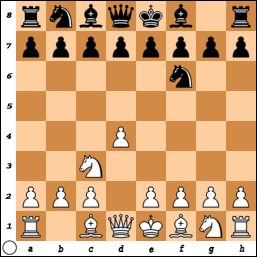
1. e4 d6
2. d4 e6
3. Nc3

Note that move 3 calls out the piece because more than one piece could move to that square (the pawn at c2 and the knight at b1) and the knight is referred to as N since the king is K. But since only one knight could move to that square it is not necessary to call out which knight is moving. If that were the case the move would be Nb1-c3 or N(b1)c3 or similar. There are several ways to notate this, but that is the general gist of it.

Oh I forgot to add, when taking a piece it is notated with an x, so would look like this bxb5 or similar depending on where the pieces were obviously. And if more than one piece can make a capture at that point it would call out the piece making the move, such as Nxb5.

I don't know how much people want this kind of running commentary but I have no problem answering questions as they come up.


edit: forgot a scenario...
 
Babe, I'll try to find the time to respond to your posts in the other thread, but for now, do you mind playing two chess matches at once? If so, I'd also like to play. :)

nyn70dr0u4fq.png
 
I'm about to break camp here to go cut and bale hay before the next storm system takes hold about ten days from now. . . . . and my "manager" wife has me sheduled for a delivery in San Bernardino county later this week, so with me it's catch as catch can right now. I do take breaks from my work here on the home front every couple of hours. Right now I'm being served milk and biscuits, with jam.

Well I wouldn't mind playing, but I would prefer to play black. Make your move, or we can get a few simultaneous games going if other people are up for it.
 
Again, for those interested, there are 2 numbering systems in general use in the chess world. Both are forms of what is called algebraic notation. Well tbh there are more than that, but what we are using here is the standard algebraic notation, which actually includes a subset of other similar systems. The other type is descriptive notation, which describes what is happening with the pieces more than just where they are on the board. In standard notation it is always presented from white's perspective with the bottom left hand square being a1. The up and down rows (from player to player) are called files, and they go up in alphabetic order (a,b,c,d, etc.). The side to side rows are called ranks and they go from 1 to 8. Hence the white queen sits on square d1, the black queen on d8.

So for standard notation, the moves would be listed in a set like this (from the current game):

Move #, white's move, black's move

1. e4 d6
2. d4 e6
3. Nc3

Note that move 3 calls out the piece because more than one piece could move to that square (the pawn at c2 and the knight at b1) and the knight is referred to as N since the king is K. But since only one knight could move to that square it is not necessary to call out which knight is moving. If that were the case the move would be Nb1-c3 or N(b1)c3 or similar. There are several ways to notate this, but that is the general gist of it.

Oh I forgot to add, when taking a piece it is notated with an x, so would look like this bxb5 or similar depending on where the pieces were obviously. And if more than one piece can make a capture at that point it would call out the piece making the move, such as Nxb5.

I don't know how much people want this kind of running commentary but I have no problem answering questions as they come up.


edit: forgot a scenario...
Thanks Log again, you clarified the things well. I also noticed my mistake of using K for the Knight, I will edit it.

One thing I could add is, when you check the opponent King, you just add a "+" symbol next to the move, so that your opponent would be aware of your check move. To give an example lets say you moved your Queen to f3 square and it threatens the opponent's King directly, you would write, ..Qf3+

Simple as that.
 
Thanks Log again, you clarified the things well. I also noticed my mistake of using K for the Knight, I will edit it.

One thing I could add is, when you check the opponent King, you just add a "+" symbol next to the move, so that your opponent would be aware of your check move. To give an example lets say you moved your Queen to f3 square and it threatens the opponent's King directly, you would write, ..Qf3+

Simple as that.

Exactly, but in your example be careful with the ellipsis. That is normally used to separate purely the black side move from the white in a given position. so ...Qf3+ would technically be black making the move.

We could go on and on about notation, but I am sure we can correct as needed as we go.
 
Back
Top