What's new

Keyonte George’s Star Ascension

I don’t mean to rain on his parade either. He could be on a Garland/Maxey trajectory. Offensively he is there. But even though those guys are bad defenders I’m hesitant to say Keyonte is even on their level. To be a str on their level he needs to defend on that level, which is really just going from awful to bad so I think it’s somewhat reasonable.

It’s an important improvement and distinction to make though. It would be like the difference between Maxey and Lavine, for example. Right now I think he’s trending more towards Lavine, who was a 2x all star btw….

I am somewhat of a Lavine apologist.
 
Individual defensive impact stats treat Keyonte as one of the worst players in the league. That is not a coincidence or a conspiracy.
I've addressed this already in another post that you still haven't responded to. It was the one where you weren't even using the correct stat, and very clearly do not understand it.
 
  • Like
Reactions: Flc
Doubt it. DFG% means you just happen to be the closest player next to a shot. When away from the rim, that includes a lot of open shots. As we know, you can’t really control open shooting. Closer to the rim it could have some validity, away from the rim is way more random.

To be clear, I’m talking about APM statistics that account for all 9 other players on the court. There’s a track record for this and it’s the basis of all higher level analytics. APM is core. I’m very open if you can’t point to anything that shows substance to these DFG%.


I’m speaking to APM metrics, which address this concern.


Perhaps, but that’s not really the point. It’s not about getting rinsed vs not getting rinsed, it’s about the extent to which we are getting rinsed. Playing with bad defenders and on a tanking team does not absolve him of his defensive output. Key’s RAPM is the worst in the entire league this season. Does that mean he is automatically the worst defender in the league? No…but it does tell us we are getting obliterated with him on the court even when accounting for his situation.
1766993152298.png

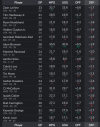
Kevin Love has the worst actual defensive EPM in the entire league. Keyonte, Collier, and WCJ are also near the very bottom of the league here.

The stat does not account for individual player situations, because there doesn't exist a stat on earth that can actually do that. The takeaway, as I've said before, isn't "Oh, the Jazz three point guards are all the worst defenders in the league".

It's, "Oh, the Jazz can't stop anything when Kevin Love is their center".
 
View attachment 19832

Kevin Love has the worst actual defensive EPM in the entire league. Keyonte, Collier, and WCJ are also near the very bottom of the league here.

The stat does not account for individual player situations, because there doesn't exist a stat on earth that can actually do that. The takeaway, as I've said before, isn't "Oh, the Jazz three point guards are all the worst defenders in the league".

It's, "Oh, the Jazz can't stop anything when Kevin Love is their center".

I was referring pure RAPM in my post, which Keyonte is very last place in. But there’s really no point in fussing over whether or not he’s worst, 5th worst, 10th worst….whatever. It’s very bad.

These numbers do not account for everything perfectly, but they do in fact account for teammate impact. It’s the best way to separate out a player’s impact from his teammates and opponents. If you have an argument as to why DFG% is actually better, I’m all ears.

PS: Having Kevin Love on the roster isn’t actually an argument as to why Key’s RAPM, EPM, etc is so bad. That’s not how these numbers work. In fact, his other numbers like DFG% are more likely to be altered. Again, APM statistics are not perfect but they directly aim to address teammate/opponent influence.
 
I was referring pure RAPM in my post, which Keyonte is very last place in. But there’s really no point in fussing over whether or not he’s worst, 5th worst, 10th worst….whatever. It’s very bad.

These numbers do not account for everything perfectly, but they do in fact account for teammate impact. It’s the best way to separate out a player’s impact from his teammates and opponents.
They are HEAVILY driven by on-court +/- relative to off-court +/-, while attempting to hold all else equal. There's 10 other variables that impact these stats. There's roles within teams that impact these stats.

What they say is that the lineups that Keyonte is in, the lineups that Collier is in, the lineups that WCJ is in, the lineups that Love is in, are all really bad defensively compared to the similar lineups that exclude them individually. People misuse this stat constantly to pretend that if you pluck another player into the same situation, whatever their EPM is from their previous situation would carry over.

If you have an argument as to why DFG% is actually better, I’m all ears.
Because it's more under Keyonte's control and more correlated with something he is actually doing. It's not a good stat either, but when it comes to what you're trying to use both of these stats for, I'd take that over RAPM easily. You shouldn't be using either really for this purpose though.

PS: Having Kevin Love on the roster isn’t actually an argument as to why Key’s RAPM, EPM, etc is so bad. That’s not how these numbers work. In fact, his other numbers like DFG% are more likely to be altered. Again, APM statistics are not perfect but they directly aim to address teammate/opponent influence.
If Love is sharing a significant portion of his minutes with Keyonte relative to other players on the team (he is), they absolutely are a significant part of the argument as to why it's so bad.

I don't think Keyonte is a good defender, at all, but it'd be nice to keep the conversation grounded in reality instead of misusing the hell out of incredibly noisy metrics.
 
No, they don't. They compare on-court +/- to off-court +/-. There's 10 other variables that impact these stats. There's roles within teams that impact these stats.

I’m sorry, but that is not how they work. Things like teammate synergy or scheme could affect these numbers, but if you don’t think the numbers address the relative strength of teammates and opponents you are misunderstood. That is the entire point of APM. Ironically, you are arguing in favor of numbers with no teammate adjustment and against numbers with teammate adjustment.

This conversation can’t continue unless you understand what APM is.

 
Year 3 Key compares well with year 3 Don and year 5 Brunson on the counting stats and offensive metrics. Interestingly all 3 are within 2.4 points of each other in net on/off impact which is a stat people seem to love these days. All three are major positives on offense, but negatives on defence. Brunson beats both guys handily in some of the other advanced numbers, but thats year 5 (Brunsons age 26 season) vs year 3. (age 22 for Key, age 23 for Don).

Even though the numbers are similar, the situations arent. Key plays for a bad team while Brunson and Mitchell played for 5th and 6th seed teams who were aiming for playoffs and clearly trending upwards in the bigger picture as well. He also has Lauri as his wingman, while Brunson had Randle and Don had Bojan who arent the same caliber guys imo.

1766993757918.png
 
Last edited:
I’m sorry, but that is not how they work. Things like teammate synergy or scheme could affect these numbers, but if you don’t think the numbers address the relative strength of teammates and opponents you are misunderstood. That is the entire point of APM. Ironically, you are arguing in favor of numbers with no teammate adjustment and against numbers with teammate adjustment.

This conversation can’t continue unless you understand what APM is.

No, I understand it quite well.

Straight from your link:

A different role, a different coaching scheme, different teammates, different match-ups, or different seasons affect APM big time.
Another issue which adjusted plus-minus technique struggles to address is the multicollinearity issue. Coaches prefer to use some player duos/trios frequently or rarely since all players could not be on the court with every other teammate at the same time.

Anybody who claims that "Having Kevin Love on the roster isn’t actually an argument as to why Key’s RAPM, EPM, etc is so bad", or that " is unfamiliar with the inherent flaws in these stats.
 
No, I understand it quite well.

Straight from your link:


Anybody who claims that "Having Kevin Love on the roster isn’t actually an argument as to why Key’s RAPM, EPM, etc is so bad", or that " is unfamiliar with the inherent flaws in these stats.

Did you read this part? I recommend you read this section and then determine whether or not it takes into account that he plays with Love sometimes. The issues you mentioned are not specific to a Key-Love pairing. If you’d like me to explain I can, but please do read this following portion:

What does adjusted plus-minus incorporate?
Every time segment a player is in a game, adjusted plus-minus tracks:
(1) The other nine players on the floor,
(2) The length of the segment,
(3) The score at the start and at the end of the segment.
 
Did you read this part? I recommend you read this section and then determine whether or not it takes into account that he plays with Love sometimes. The issues you mentioned are not specific to a Key-Love pairing.

What does adjusted plus-minus incorporate?
Every time segment a player is in a game, adjusted plus-minus tracks:
(1) The other nine players on the floor,
(2) The length of the segment,
(3) The score at the start and at the end of the segment.

There's a giant difference between "it takes into account" and "it is not impacted by".

You're trying to pretend it is saying the latter with a statement like "Having Kevin Love on the roster isn’t actually an argument as to why Key’s RAPM, EPM, etc is so bad".

Despite what you claim, and as your link itself explicitly states, the metric is heavily impacted by who your teammates are and what your role is.
 
There's a giant difference between "it takes into account" and "it is not impacted by".

You're trying to pretend it is saying the latter with a statement like "Having Kevin Love on the roster isn’t actually an argument as to why Key’s RAPM, EPM, etc is so bad".

Despite what you claim, and as your link itself explicitly states, the metric is heavily impacted by who your teammates are and what your role is.

You realize it’s affected by your teammates because it accounts for the strength of your teammates. It doesn’t punish you for having worse teammates, it sees that you have worse teammates and adjust the individual rating because of it. That is the entire point of the stat.

For example, if you have Kevin Love on your team and he is bad, it will adjust to the fact that Kevin Love is bad. That is the “Adjusted” part of Adjusted Plus Minus.

Let’s just say Kevin Love makes every lineup 5 points worse on his own. Keyonte now plays minutes with Kevin Love. If those lineups are only -4, that will look good for Key and he’ll be a “+1” despite being -4.

Love’s presence does not explicitly make Key’s APM worse because he is bad. This is why I say that "Having Kevin Love on the roster isn’t actually an argument as to why Key’s RAPM, EPM, etc is so bad". APM (and other variations) exist to separate an individual’s impact from his teammates. You can have a bad on/off an a good APM and vice versa. That is because APM accounts for teammate impact.
 
You realize it’s affected by your teammates because it accounts for the strength of your teammates. It doesn’t punish you for having worse teammates, it sees that you have worse teammates and adjust the individual rating because of it. That is the entire point of the stat.

For example, if you have Kevin Love on your team and he is bad, it will adjust to the fact that Kevin Love is bad. That is the “Adjusted” part of Adjusted Plus Minus.

Let’s just say Kevin Love makes every lineup 5 points worse on his own. Keyonte now plays minutes with Kevin Love. If those lineups are only -4, that will look good for Key and he’ll be a “+1” despite being -4.

Love’s presence does not explicitly make Key’s APM worse because he is bad. This is why I say that "Having Kevin Love on the roster isn’t actually an argument as to why Key’s RAPM, EPM, etc is so bad". APM (and other variations) exist to separate an individual’s impact from his teammates. You can have a bad on/off an a good APM and vice versa. That is because APM accounts for teammate impact.
I guess I need to repeat my previous post: There's a giant difference between "it takes into account" and "it is not impacted by".

The stat doesn't do the latter. This isn't up for debate - they explicitly say "A different role, a different coaching scheme, different teammates, different match-ups, or different seasons affect APM big time."

If you have a problem with that statement, take it up with them.
 
Back
Top