What's new

AntiAusterity reigns in European politics

I don't think that Fannie and Freddie are wholly a government entity. It was out to make a profit and yet was stuck with a duty to give home loans to the low income families. Started under the first Bush administration. https://en.wikipedia.org/wiki/Fannie_Mae This was the rock and the hard place that they were stuck in. Yet, with watered down regulations who is to blame anyone of trying to make the most out of what is given you. Destructive greed.

I was just trying to point out that what those companies did is a result of the rules they were given by the government. Rules established mostly by the Dems (again I could be wrong). Now that does not disolve the companies them selves or the people who signed those loans of their stupidity.
 
YOu do not think that greed has put us where we are? I would love to hear why.

I never said I was for equality. What I'm for is when is someone going to realize that the gap between the rich and the poor is out of control. I have no problem with greed there are times when greed is a force of good and there are times when greed is a force of destruction. When Goldmann Sachs tells group A of to 'buy' then they tell group B to 'hedge against that same stock'. That is destructive greed. When a bank tells its loan officers to push predatory loans on an uneducated public. That is destructive greed.

I disagree. I think that is criminal behavior. It's not capitalism or greed or whatever else you want to call it. That is lying cheating and stealing to get what you want. We all want and we all put in some degree of effort to get what we want. There is no limit to the amount any of us wants, just the realization that we can't always have everything we want.

greed = life

Yes let us put an end to human desire. That will fix all our problems. Only, once we no longer want anything we will stop striving to accomplish anything.
 
Lets look at this in another light lets compare the capitalistic market to the BCS. I don't know if you are pro or anti BCS. But, when the big conferences are the ones making the rules due to the $$$ that they have what is stopping corruption? When Utah wasn't a part of the BCS people were up in arms about the inequality of the conferences. But, now that they are part of a BCS conference look at how many people are changing their minds. We can't blame anyone for doing corrupt deals when the system reward this reckless behavior.
 
I disagree. I think that is criminal behavior. It's not capitalism or greed or whatever else you want to call it. That is lying cheating and stealing to get what you want. We all want and we all put in some degree of effort to get what we want. There is no limit to the amount any of us wants, just the realization that we can't always have everything we want.

greed = life

Yes let us put an end to human desire. That will fix all our problems. Only, once we no longer want anything we will stop striving to accomplish anything.

The scene from the movie Serenity comes to mind. They developed a drug to weed out aggression. Well what that did is rob people of their desire. So eventually the entire planet laid down and just let themselves die.
 
This is turning into an arguement on greed and I honestly have no desire to debate that at the moment. So I am out.!
 
I grew up in NYC which has a very high tax rate. My family and I were able to enjoy things like free after school programs, free garbage pick up. As I got older, I went to a state subsidized school that let me study for less than 1K a semester and I could travel on the subway at 3 in morning instead of driving home with a buzz on.

In my late 20's I moved to Round Rock Texas and lived there for 4 years. Zero social services - if anything happens to you, you're pretty much on your own. But there is a much lower cost of living, no state taxes and low proper taxes that enabled me to have more disposible income.

Both places had their advantages and drawbacks. The problem is people want their cake and be able to eat it to. Greece, Spain and Italy are all prime examples. Greece especially is a ****ing joke. The working class wants to keep all the government programs - but NO ONE, rich or poor wants to pay any taxes. Cheating on your taxes and hiding your income is almost a national past time in Greece - which may have something to do with the fact that they really have no equivalent to the IRS.

The bottom line is the electorate as a whole needs to make a choice. Countries, like Germany, Sweden and Norway all have extensive government programs; but they also have high tax rates that pay for them; which is why they're not on the brink of collapse like the rest of Europe.

Luckily for us and unlike are friends on the Euro, we can just print money whenever we want (yes, that was sarcasm).
 
I grew up in NYC which has a very high tax rate. My family and I were able to enjoy things like free after school programs, free garbage pick up. As I got older, I went to a state subsidized school that let me study for less than 1K a semester and I could travel on the subway at 3 in morning instead of driving home with a buzz on.

In my late 20's I moved to Round Rock Texas and lived there for 4 years. Zero social services - if anything happens to you, you're pretty much on your own. But there is a much lower cost of living, no state taxes and low proper taxes that enabled me to have more disposible income.

Both places had their advantages and drawbacks. The problem is people want their cake and be able to eat it to. Greece, Spain and Italy are all prime examples. Greece especially is a ****ing joke. The working class wants to keep all the government programs - but NO ONE, rich or poor wants to pay any taxes. Cheating on your taxes and hiding your income is almost a national past time in Greece - which may have something to do with the fact that they really have no equivalent to the IRS.

The bottom line is the electorate as a whole needs to make a choice. Countries, like Germany, Sweden and Norway all have extensive government programs; but they also have high tax rates that pay for them; which is why they're not on the brink of collapse like the rest of Europe.

Luckily for us and unlike are friends on the Euro, we can just print money whenever we want (yes, that was sarcasm).

How would that work? Those who get the benefits would vote for the ones giving them the benefits to keep on doing it.

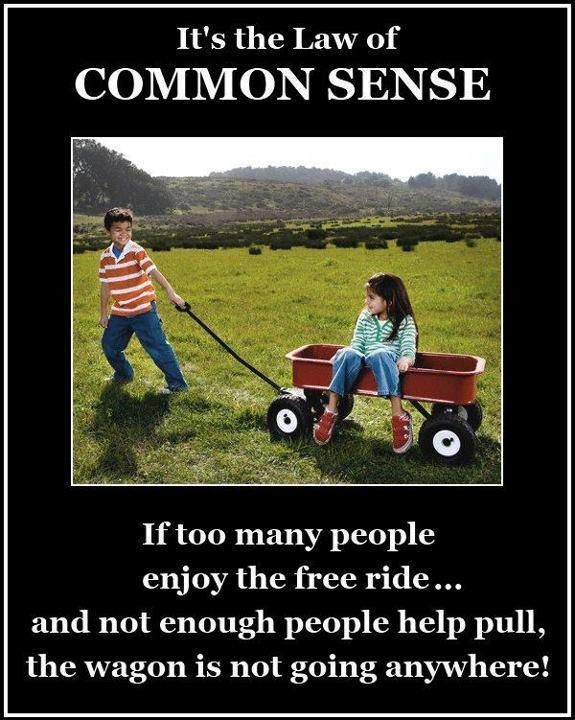
law_of_common_sense_free_ride.jpg
 
New fed regulation laws didn't stop JP Morgan Chase from losing 2 billion in 6 weeks. Most regulation causes as many problems as it proposes to fix.

I think you're extrapolating way to much to prove a point, FT. Sure regulation may not stop them from losing the $2 billion but it can go after them and scare others away from following suit. Isn't that the whole point of punishment?

I get the point that Wall Street will find ways around regulation but your unintended consequences argument makes no sense to me here. We need to reform regulation to keep up with the times and not abandon it altogether. There were many things that contributed to the great recession, and forgetting the bank regulation lessons learned during the great depression was a huge factor.

I've said this many times before: banking is born out of government, and as such, should be regulated tightly. I find it absurd when limited government/free market advocates push to remove checks and balances from something that is an extension of government. You should be arguing for tighter regulation of banks in order to preserve the integrity and stability of the free market (think of national defense as an analogy).
 
Both places had their advantages and drawbacks. The problem is people want their cake and be able to eat it to. Greece, Spain and Italy are all prime examples. Greece especially is a ****ing joke. The working class wants to keep all the government programs - but NO ONE, rich or poor wants to pay any taxes. Cheating on your taxes and hiding your income is almost a national past time in Greece - which may have something to do with the fact that they really have no equivalent to the IRS.

I listened to an expert on Greece give a speech on NPR and he said most these talking points are completely fabricated.

The problem with Greece is something that will always happen with a central monetary authority without a central government.
 
Lets look at this in another light lets compare the capitalistic market to the BCS. I don't know if you are pro or anti BCS. But, when the big conferences are the ones making the rules due to the $$$ that they have what is stopping corruption? When Utah wasn't a part of the BCS people were up in arms about the inequality of the conferences. But, now that they are part of a BCS conference look at how many people are changing their minds. We can't blame anyone for doing corrupt deals when the system reward this reckless behavior.

Corruption, coercion, lying, cheating and stealing are all criminal acts, in my opinion, when you use them as a business strategy. All companies want to succeed and make profits. It isn't so simple as to blame greed when an organization starts breaking the law to succeed. We have to call it criminal behavior and go after the criminals. I think lack of enforcement and meaningless penalties against companies that engage in criminal activity has greatly damaged the average person's view of free market economics. In my opinion a company that becomes a criminal enterprise by lying, cheating and stealing should be shut down and the people in charge should go to prison, period. That would be my first step in repairing peoples' view of free markets.
 
I think you're extrapolating way to much to prove a point, FT. Sure regulation may not stop them from losing the $2 billion but it can go after them and scare others away from following suit. Isn't that the whole point of punishment?

I get the point that Wall Street will find ways around regulation but your unintended consequences argument makes no sense to me here. We need to reform regulation to keep up with the times and not abandon it altogether. There were many things that contributed to the great recession, and forgetting the bank regulation lessons learned during the great depression was a huge factor.

I've said this many times before: banking is born out of government, and as such, should be regulated tightly. I find it absurd when limited government/free market advocates push to remove checks and balances from something that is an extension of government. You should be arguing for tighter regulation of banks in order to preserve the integrity and stability of the free market (think of national defense as an analogy).

2 billion is nothing. All those banks have losses 1000X greater just waiting to realized on their books, but aren't because of accounting gimmickry and monetary gimmickry. But all the ballyhoo over JPM's trade gone amiss seems to end in talk of the Volcker rule and Glass Steagall being implemented, which I think is sensible to most. That's certainly not a left wing, anti-free market position.

I think most free marketers are the ones supporting Glass Steagall reinstatement, supporting a regulated transparent derivatives market, supporting changes to the way The Fed is run, supporting outlawing bailouts, supporting tighter anti-trust rules. That all fits under the umbrella of both regulation and a free market with competition enabling laws.
 
Than we Romney used the system when he was at Bain capital and would make money whether or not he was able to pull the company out and resale it at a larger amount of $$$. Or leveraged against that companies assets and didn't pay back any of the money and let the company flop. That was technically not lying, etc. When you have the money you have the power and you make the rules. We need check and balances for companies so they don't try to buy their success.
 
Back
Top