
You are using an out of date browser. It may not display this or other websites correctly.
You should upgrade or use an alternative browser.
You should upgrade or use an alternative browser.
President Obama’s nomination of Merrick Garland for the Supreme Court
- Thread starter Scat
- Start date


♪alt13
Well-Known Member
They own in the senate because of more healthcare and economic reasons in last midterm and own the House because of gerrymandering.
How many Democratic Senators in the purple states below do you think have adopted a pro-gun stance? How many have adopted Republican economics?
If it wasn't such a big issue than Dems wouldn't use it to get elected in purple states, but they do. They don't win those seats by talking about tax breaks. You're wrong
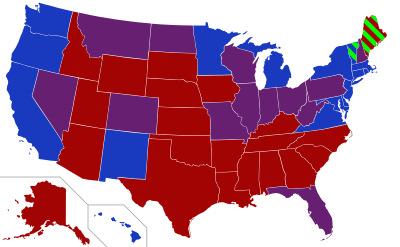
Senate Seats
Blue states= 2(D)
Red States= 2(R)
Purple=1(D)&1(R)
Green=(I)

D
Deleted member 848
Guest
lol GOP

I wrote to my senators Orrin Hatch and Mike Lee yesterday about this issue. Not that it will do any good, but it made me feel a tiny bit better.
I do not agree with the idea that Republicans are spouting that to "know the will of the people" we need to wait until the next President is elected. As I recall, President Obama was voted into office in the last election for the years 2013-2016. That was the will of the people. It didn't end on December 31, 2015. It's a terrible argument.
If Republicans with power had any sense, which is becoming somewhat doubtful, they would jump all over this nomination. It is becoming increasingly obvious that a Republican will not win the general election, and the self-destructive nature of the party may have a large impact on many other federal elections. There is a chance that the next president will be in a position to install a much more liberal judge.
The idea that Republicans decided that they would not consider any nominee disgusts me. Do Your Job!
I do not agree with the idea that Republicans are spouting that to "know the will of the people" we need to wait until the next President is elected. As I recall, President Obama was voted into office in the last election for the years 2013-2016. That was the will of the people. It didn't end on December 31, 2015. It's a terrible argument.
If Republicans with power had any sense, which is becoming somewhat doubtful, they would jump all over this nomination. It is becoming increasingly obvious that a Republican will not win the general election, and the self-destructive nature of the party may have a large impact on many other federal elections. There is a chance that the next president will be in a position to install a much more liberal judge.
The idea that Republicans decided that they would not consider any nominee disgusts me. Do Your Job!

Joe Bagadonuts
Well-Known Member
Yep. GOP is playing with fire here. The chances are very, very good that they will end up being forced to accept a much more liberal, activist judge. Clinton would force them to for sure. Sanders wouldn't even consider a moderate. Anybody who thinks they have any idea what Trump would do isn't paying attention. Cruz would go far more conservative. Does anybody honestly believe he will win?


Duck Rodgers
Well-Known Member
Play up the issue of them taking this to avoid a more liberal justice and that it is proof that the liberals want to weaken the 2nd amendment.
But as stated the GOP is dumb.
It's not tough to predict what will happen here. They are going to fold. The Mitch McConnels of the world will spend their days over the next few months/weeks playing up to the media of how tough they are against the nomination like they always do ..... so they can sell how hard they fought , for a few months before folding, to their voters that want to hear that come election time.....and at night Mitch McConnel and Harry Reid(or other public figure opposition) will be hanging out and splitting the cost of a Georgetown prostitute while discussing how they can continue to screw everyone further after the current charade is over. That's how DC works. All a show.
I wrote my senators a couple of weeks ago about my disapproval of not even pretending to consider Merrick Garland for the Supreme Court. This is my response from Orrin Hatch:
As if the toxic environment will go away after the election.
Thank you for writing to me regarding the United States Supreme Court. I appreciate hearing from you and welcome the opportunity to respond.
As you may know, the Constitution grants the President the power to nominate a candidate for the vacancy left after Supreme Court Justice Antonin Scalia’s untimely death. The Constitution separately gives the Senate the power of advice and consent regarding a nomination. President Obama’s supporters repeat the slogan that the Senate must “do its job” with respect to the Scalia vacancy, and I agree. The Senate’s job is to determine the most appropriate way to fulfill our advice-and-consent role in the particular circumstances surrounding this vacancy. The Senate would not be doing its job, for example, if it structured the confirmation process in a way that was more appropriate for a situation different than the one we face today. In addition, withholding consent can be just as valid an exercise of the Senate’s role as granting it, and deferring the confirmation process can be just as appropriate as proceeding with it immediately.
I am convinced that the best way for the Senate to exercise its advice-and-consent responsibility regarding the Scalia vacancy is to hold consideration of a nominee after the election season is over. Both the confirmation process and the current presidential campaign, which is already well underway, have become confrontational and divisive. Considering a nomination in the middle of a contentious presidential election would be unfair to the nominee and could damage the judicial confirmation process even further. The goal of minimizing the politics surrounding the confirmation process is better served by conducting thoughtful deliberation after the presidential election season has come to an end.
Waiting to confirm a nominee is also necessary to respect the will of the American people after the 2014 mid-term election. Elections have consequences, and in the last election, the American people elected a Republican Senate majority to help check the President’s power. The decision by Senate Republicans to wait until after the election to confirm a nominee is simply a fulfillment of that promise. Americans will again make their voices known in the 2016 election when they vote for a President who will decide the direction of our nation’s highest court.
The issue is when—not whether—the confirmation process should occur for the Scalia vacancy. I remain convinced that the Senate can best do its job by conducting the confirmation process after this toxic presidential election season is over. Doing so is the best way to ensure fairness to a nominee, preserve the integrity of the judicial branch, and give the American people a voice in the direction of the Supreme Court.
I have served longer on the Judiciary Committee than all but one Senator in the committee’s history. During these past four decades, including eight years as chairman of the committee, I have worked hard to be fair toward the nominees chosen by Presidents of both parties. I have absolutely no doubt that my decision regarding the current vacancy fits squarely within this record of fairness.
Thank you, again, for contacting me with your comments. If you would like to have regular updates on my work in the U.S. Senate, I encourage you to subscribe to my E-newsletter, visit my Facebook page, and follow me on Twitter.
Your Senator,
Orrin G. Hatch
United States Senator
As if the toxic environment will go away after the election.

As if the toxic environment will go away after the election.
You could reply saying, "Dear senator, with actions like this YOU ARE CONTRIBUTING TO THE TOXIC ENVIRONMENT."
It wouldn't do any good, but might make you feel better.
