What's new

Serious quesiton for people who deny human involvement in climate change/global warming

excellent link.

In the 1970s I was reading about the coming Ice Age and the need to avert all discussion and rush headlong into vast global programs to save humanity from impending doom. One way or another, it the impetus of big thinkers to fix every hobgoblin on the intellectual horizons. Maybe we could have guvmint solve both extreme predictions and claim they are right whichever way it goes. Climate Change, that's the ticket.

on the face of it, the ability of the earth's oceans to absorb CO2 might seem like an inexhaustible "sink" that can handle all we can burn. Think of it. We have tens of thousands of feet of carbonate rock deposits that were formed under warm shallow seas. All that CO2 came from the atmosphere, and depleted the magnesium and calcium salt content of the oceans, and it recycles as rock is heated by plutonic masses or volcanos, and all that.

But I think both the Sun's energy processes, and the collision of the earth with varying densities of particulates as it sweeps through space, with resulting changes in upper atmospheric temperature and energetic ions are massive enough to have long-cycle impacts that dwarf our carbon emissions. Not much we can do about either, and I think the historical data we have compiled in scientific research of ice cores and sediment cores suggests that most ice ages are preceded by temp spikes of around 10 degrees Celsius, about an order magnitude more than our calculated or measured warming due to our carbon emissions.

Meanwhile, cold fusion is steadily gaining scientific basis and is looking credible to some serious, careful researchers, even while the oil industry scientists have completed hammered it as a "solution" going forward. I am a supporter of nuclear development of thorium resources and other nuclear technologies once we figure out how to use them safely.


thas because people act lik escience is the absolute TRUTH.
always flip flopping. so when u question something you are stupid.

but in fact science is always about questioning and trying to prove stuff.

people claiming science has disproven god. on the countrary ask real scientist(neil de grasse tyson isnt a real scientist) about god. they will say there is No prove he exist. but there is also no prove he does not.


science keeps changing.


if this global warning was really a dire situation, those people screaming the loudest would lead by example and go full on amish.
Ozon depletaion was real, and everyone did something about that. finally the ozon hole is CLOSING!
 
excellent link.

In the 1970s I was reading about the coming Ice Age and the need to avert all discussion and rush headlong into vast global programs to save humanity from impending doom. One way or another, it the impetus of big thinkers to fix every hobgoblin on the intellectual horizons. Maybe we could have guvmint solve both extreme predictions and claim they are right whichever way it goes. Climate Change, that's the ticket.

on the face of it, the ability of the earth's oceans to absorb CO2 might seem like an inexhaustible "sink" that can handle all we can burn. Think of it. We have tens of thousands of feet of carbonate rock deposits that were formed under warm shallow seas. All that CO2 came from the atmosphere, and depleted the magnesium and calcium salt content of the oceans, and it recycles as rock is heated by plutonic masses or volcanos, and all that.

But I think both the Sun's energy processes, and the collision of the earth with varying densities of particulates as it sweeps through space, with resulting changes in upper atmospheric temperature and energetic ions are massive enough to have long-cycle impacts that dwarf our carbon emissions. Not much we can do about either, and I think the historical data we have compiled in scientific research of ice cores and sediment cores suggests that most ice ages are preceded by temp spikes of around 10 degrees Celsius, about an order magnitude more than our calculated or measured warming due to our carbon emissions.

Meanwhile, cold fusion is steadily gaining scientific basis and is looking credible to some serious, careful researchers, even while the oil industry scientists have completed hammered it as a "solution" going forward. I am a supporter of nuclear development of thorium resources and other nuclear technologies once we figure out how to use them safely.

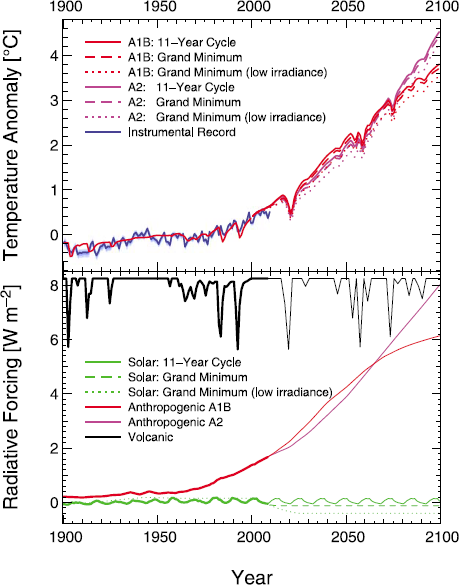
link to paper>https://www.pik-potsdam.de/~stefan/Publications/Journals/feulner_rahmstorf_2010.pdf

FeulnerRahmstorf.png
 
So, to check reality a bit, what I'm actually talking about is in line with, perhaps, the "dark matter" which lacks sufficient objective characterization to fit perfectly with some folk's view of materialism, because it's undefined or not understood clearly, but not necessarily. For fun, here's a little link for the ordinary readers:

https://www.whillyard.com/science-pages/anomalies.html

I don't know everything. Sometimes rhetoric seems like some oriental martial arts idea like "wave hands like clouds", or change positions so fast nobody can pin you down, but for me our understanding of our material and scientific universe is annoyingly uncertain.

Aha. So you looked into your god's shelter, found out it's indeed made-up of dark matter, so now it's time for some backpedaling. No matter. It's not like I was expecting some ground breaking defense of immaterialism. So I'll play along.

The evidence for the existence of matter that only interacts through gravity (and possibly weak force) is quite compelling. It is not only seen in the gravitational effect on far-away objects, but also more directly in the way it bends light around itself, which is used in technology in what is called gravitational lensing. Indirectly, the effect it has on galactic rotational curves and star velocities is perfectly consistent with the presence of electromagnetically non-interactive mass and not at all with any kind of variable gravity hypotheses. There is also the effect on the distribution of energy in the cosmic background radiation, which fits perfectly with that of dark matter. There's plenty else actually. We've known about dark matter since the 1930s, and a ton of evidence for its existence has been gathered since. I'm sure you can easily find books or websites that explain the current state of affairs.

Now for the subject of materialism that you can't help but bring up every chance you get. May I ask why? You keep citing the incompleteness of science as if that's a compelling argument, but you must know it isn't. Science is a process. Since collection of knowledge requires that one starts from a point of relative ignorance, science can be nothing but incomplete. To keep bringing up current shortcomings in the understanding of physics is incredibly small minded. History has shown us that knowledge will continue to grow. Why put yourself in a position where you'll have to keep looking for gaps to hide in, and ways to cast doubt on facts that no longer fit your preferred configuration of the universe? It must be exhausting.

Whenever I asked you to explain this immaterialist god that you're so attached to, it always goes back to the same old "you cannot explain the immaterial through the material". But the existence of a creator is not related to materialism whatsoever. It is perfectly possible that the universe is fully materialist and yet created. The immaterialist criterion is an imposition of your own creation. The reasons for its existence are wholly subjective to your person. It does not exist without, and it cannot be communicated. So why keep bringing it up? Does it really bother you that some of us cannot accept your subjective experience as guide to our thought? Come on.
 
Aha. So you looked into your god's shelter, found out it's indeed made-up of dark matter, so now it's time for some backpedaling. No matter. It's not like I was expecting some ground breaking defense of immaterialism. So I'll play along.

The evidence for the existence of matter that only interacts through gravity (and possibly weak force) is quite compelling. It is not only seen in the gravitational effect on far-away objects, but also more directly in the way it bends light around itself, which is used in technology in what is called gravitational lensing. Indirectly, the effect it has on galactic rotational curves and star velocities is perfectly consistent with the presence of electromagnetically non-interactive mass and not at all with any kind of variable gravity hypotheses. There is also the effect on the distribution of energy in the cosmic background radiation, which fits perfectly with that of dark matter. There's plenty else actually. We've known about dark matter since the 1930s, and a ton of evidence for its existence has been gathered since. I'm sure you can easily find books or websites that explain the current state of affairs.

Now for the subject of materialism that you can't help but bring up every chance you get. May I ask why? You keep citing the incompleteness of science as if that's a compelling argument, but you must know it isn't. Science is a process. Since collection of knowledge requires that one starts from a point of relative ignorance, science can be nothing but incomplete. To keep bringing up current shortcomings in the understanding of physics is incredibly small minded. History has shown us that knowledge will continue to grow. Why put yourself in a position where you'll have to keep looking for gaps to hide in, and ways to cast doubt on facts that no longer fit your preferred configuration of the universe? It must be exhausting.

Whenever I asked you to explain this immaterialist god that you're so attached to, it always goes back to the same old "you cannot explain the immaterial through the material". But the existence of a creator is not related to materialism whatsoever. It is perfectly possible that the universe is fully materialist and yet created. The immaterialist criterion is an imposition of your own creation. The reasons for its existence are wholly subjective to your person. It does not exist without, and it cannot be communicated. So why keep bringing it up? Does it really bother you that some of us cannot accept your subjective experience as guide to our thought? Come on.

I find it interesting the argument that since 'science does not have all the answers' or 'science is sometimes wrong,' or some variant of this argument, the solution inevitably proposed is to substitue a proven, objectively verificable, replicable, process that has proved itself time and time again and has had such a profound impact on every aspect of our lives (including increasing the longetivity and reducing the morbidiy of said lives) with a totally unproven, wholly subjective, non-verifiable, non-replicable belief that has produced none of the benefits that science has, and which, in its application, as created untol misery, suffering, oppression, bad ideas, and so forth.

I suppose it's true, science may not always get it right, in the moment at least (it usually does over time), but what are the odds that it will produce a better answer to critical questions than religion, or some other faith-based belief or idelogocial/dogmatic belief?
 
I find it interesting the argument that since 'science does not have all the answers' or 'science is sometimes wrong,' or some variant of this argument, the solution inevitably proposed is to substitue a proven, objectively verificable, replicable, process that has proved itself time and time again and has had such a profound impact on every aspect of our lives (including increasing the longetivity and reducing the morbidiy of said lives) with a totally unproven, wholly subjective, non-verifiable, non-replicable belief that has produced none of the benefits that science has, and which, in its application, as created untol misery, suffering, oppression, bad ideas, and so forth.

I suppose it's true, science may not always get it right, in the moment at least (it usually does over time), but what are the odds that it will produce a better answer to critical questions than religion, or some other faith-based belief or idelogocial/dogmatic belief?

I am actually comfortable saying that science is the ONLY sincere pursuit of knowledge.
 
so, srs, when would you say that science was invented?

This is a difficult question to answer. Some of the foundations of the scientific method had been invented by the time of the Ancient Greeks, and very probably earlier. I'm sure it also existed in the East and elsewhere, but I am less familiar with those histories. It was advanced by the Muslims and early Christians, and formalized in the High Middle Ages.

However, the seeds of science had probably existed since before the time of homo sapiens. I would not be surprised if earlier hominid wanderers had individuals who conducted simple experiments to create useful and reproducible results.
 
This is a difficult question to answer. Some of the foundations of the scientific method had been invented by the time of the Ancient Greeks, and very probably earlier. I'm sure it also existed in the East and elsewhere, but I am less familiar with those histories. It was advanced by the Muslims and early Christians, and formalized in the High Middle Ages.

However, the seeds of science had probably existed since before the time of homo sapiens. I would not be surprised if earlier hominid wanderers had individuals who conducted simple experiments to create useful and reproducible results.

repped for the second paragraph.

I think the only defensible stance on the invention of science, IF you're someone with the view that science is the ONLY sincere pursuit of knowledge, is to cast its origin into the very origin of the species.


But this does lead to more questions:
What do you mean by 'sincere'?
 
repped for the second paragraph.

I think the only defensible stance on the invention of science, IF you're someone with the view that science is the ONLY sincere pursuit of knowledge, is to cast its origin into the very origin of the species.


But this does lead to more questions:
What do you mean by 'sincere'?

I meant that it is the only system that is honest about its objective; providing explanations with the main pre-conception being that explanations are possible. Keep in mind that I am disregarding the subjective nature of sincerity, and using the term in a more abstract manner. An individual can sincerely believe that repeating a mantra would compel the universe to impart knowledge upon the individual. But I am talking about the sincerity of the concept, not of the person.
 
I meant that it is the only system that is honest about its objective; providing explanations with the main pre-conception being that explanations are possible. Keep in mind that I am disregarding the subjective nature of sincerity, and using the term in a more abstract manner. An individual can sincerely believe that repeating a mantra would compel the universe to impart knowledge upon the individual. But I am talking about the sincerity of the concept, not of the person.

to the post as a whole:
Ok, I get that. I get that sense of reaching beyond one's previous expectations and beliefs in order to experiment and find new effects in things. (And, as my previous post indicates, I'd place that practice into the core of any presumed human essence.)

to the bolded:
I'm always weary of this abstraction because, in reality and in truth, it is impossible to subtract the subjective nature of reaching beyond. We never get beyond our own sensations (and all their training) of the present world. What compels us to reach for "sincere knowledge"? What sides of things are we seeing this time...(because we obviously aren't seeing all sides simultaneously)?
 
Last edited:
to the post as a whole:
Ok, I get that. I get that sense of reaching beyond one's previous expectations and beliefs in order to experiment and find new effects in things. (And, as my previous post indicates, I'd place that practice into the core of any presumed human essence.)

to the bolded:
I'm always weary of this abstraction because, in reality and in truth, it is impossible to subtract the subject nature of reaching beyond. We never get beyond our own sensations (and all their training) of the present world. What compels us to reach for "sincere knowledge"? What sides of things are we seeing this time...(because we obviously aren't seeing all sides simultaneously)?

What compels us to reach for knowledge is, in part, the power it gives us. With computing knowledge, you can create machines that can solve equation that used to take a lifetime in a few seconds. With knowledge of nuclear physics you can create weapons that can level cities. And while I know there is something deeper about the compulsion, I don't think it's entirely separate. I don't know how it exactly arises, but I suspect it is an enviable consequence of being able to comprehend the existence of an explanation, or at the very least the existence of the question. The brain structure that gives rise to the compulsion is very probably the product of the same evolutionary mechanism that gave rise to our intelligence in the first place. What it is the evolutionary advantage of possessing enough intelligence if not to use it in practice? So I suspect the ability to use to technology is what drives the deeper compulsion to seek explanations for their own sake. But I do not know enough about the neurological structure of the brain to come up with a comprehensive hypothesis. I'm not even sure neuroscience is at that level yet.

I don't think I understand the second question. What do you mean by sides? We are able to see all the sides that we've learned about. Ones that have not been discovered, by definition, are outside of our current reach.
 
Siro, I actually enjoy your valiant defense of materialism in the face of what you term my "subjective experience". Consciousness is "subjective experience" on the same level of definition as measurement, experiment, observation, and such. Wish I had more time right now to explore all this and discuss it with you.
 
Back
Top