What's new

Tax Cuts

  • Thread starter Thread starter Deleted member 365
  • Start date Start date
Don't worry about it. Helicopter Ben Bernanke is going to give you the biggest tax of your lifetime in the form of inflation so the 3 or 4 percentage bump income tax is almost irrelevant right now.

There is virtually no evidence of inflation over the last two years. At one point this last week, real yields on 5-year inflation protected treasury bonds was negative, implying deflationary pressures.
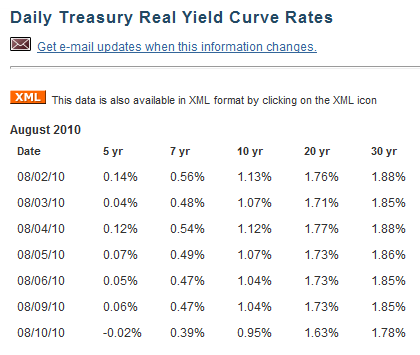
tipscurve.PNG


In the period since late 2008 when the Fed pushed the fed funds rate to 0% inflation has been virtually non-existent. The average rate of inflation was actually slightly negative in 2009 and the yearly inflation rate for 2010 is looking like it will end up at around 2%, which would still be lower than every year of the Bush administration except for 2002.

Furthermore, the best current studies indicate that periods of prolonged recession are correlated with falling inflation rates almost without exception.

Fears of hyperinflation are not based in the facts and have more than a little to do with the desire for the apocalypse to strike so that those presently in charge can be blamed for it.

Romney's whole background is gutting things and making them better - how can anybody argue that he wouldn't be a perfect fit if he was that same guy? That's exactly what we needed in '08 and even more so now. The question with him is if he is an establishment guy that just goes with the flow or not. Based on his record as Governor of Mass and being a member of quite a few of the elite "clubs", the answer is that he is indeed an establishment guy. But you never know if he is just playing the field so he can get a shot at the big job. He is the only name that floats with a legitimate chance to actually do something positive for this country.

I think it's clear that you like Romney for reasons that are not policy-based.
 
I don't get why conservatives/libertarians never talk about cutting military spending when they talk about making cuts.

I would much rather cut off some military base in japan or get the hell out of Iraq thus forcing some of these people to get involved in private industries here before I'd cut grandpa's medical care or some poor person's food stamps.

I get the whole idea of cutting spending. But why is military spending only brought up by the "liberals" and never by the crowd that is suddenly upset with the deficit (after being silent for 8 years)? So we'd rather cut our own benefits basically and throw billions away to foreign countries? Can't we be a little selfish here?

Seriously, could anyone give me a true response to this?

see Gameface's post, #21

those who follow the conservative/libertarian line of thinking tend to believe the national government should play a very limited role in the everyday lives of its citizens; they view national defense as one of the only vital functions the national government should provide to its citizens (and perhaps also infrastructure such as roads and bridges)
 
NAOS, thank you for your service. Teaching is a very diffifult profession and I know I could not do it. I agree with you on a number of things, however, I do have a major problem with the amount of money we pay in taxes. I have 3 central problems.

1. While I agree that institutions are important, I think that history has shown that governments (not just ours, but all governments) do a poor job of alocating resources and there tends to be a great deal of waste. This really ticks me off because, I'm all for a strong military, an excellent educational system, quality roads, etc, however, in a system where waste is tolerated it means that a good percentage of what I pay in taxes is not going for it's designed purpose.

2. The culture in Congress has become one where the representatives, their constituents and the media cheer when a member of congress gets a "pork belly" project for their district. It's not just democrats, republicans have gotten in on the act. When Ted Stevens died last week, one of the big things they said about him was, "he brought a lot of federal projects to Alaska." Guess what? That's my money. That culture creates corruption and the above mentioned waste.

3. The size of the federal government. This is not directed specifically at the U.S. Federal Government but at any organization that reaches a certain size. In my opinion, every organization reaches a point where it is too big to effectively manage itself. I think the U.S. Federal Government hit that point decades ago. Local and State government is more representative of her constituents and better able to adapt to the needs of the people it is supposed to serve. Don't get me wrong, I'm not for dismantling the Federal Government, however, I am in favor of shrinking it back. The Federal Government is wonderful when it comes to defense, innerstate commerce, providing standards for education, food quality, worker's rights, etc. However, it needs to pass some of the important responsiblities off to the states and other local governments who will run those programs more effectively.
 
NAOS, thank you for your service. Teaching is a very diffifult profession and I know I could not do it. I agree with you on a number of things, however, I do have a major problem with the amount of money we pay in taxes. I have 3 central problems.

1. While I agree that institutions are important, I think that history has shown that governments (not just ours, but all governments) do a poor job of alocating resources and there tends to be a great deal of waste. This really ticks me off because, I'm all for a strong military, an excellent educational system, quality roads, etc, however, in a system where waste is tolerated it means that a good percentage of what I pay in taxes is not going for it's designed purpose.

2. The culture in Congress has become one where the representatives, their constituents and the media cheer when a member of congress gets a "pork belly" project for their district. It's not just democrats, republicans have gotten in on the act. When Ted Stevens died last week, one of the big things they said about him was, "he brought a lot of federal projects to Alaska." Guess what? That's my money. That culture creates corruption and the above mentioned waste.

3. The size of the federal government. This is not directed specifically at the U.S. Federal Government but at any organization that reaches a certain size. In my opinion, every organization reaches a point where it is too big to effectively manage itself. I think the U.S. Federal Government hit that point decades ago. Local and State government is more representative of her constituents and better able to adapt to the needs of the people it is supposed to serve. Don't get me wrong, I'm not for dismantling the Federal Government, however, I am in favor of shrinking it back. The Federal Government is wonderful when it comes to defense, innerstate commerce, providing standards for education, food quality, worker's rights, etc. However, it needs to pass some of the important responsiblities off to the states and other local governments who will run those programs more effectively.

You bring up some interesting points. For the sake of discussion I'll just do a little bit of speculation and contextualization; these issues are, of course, more complex than we usually make them.

As for #2, this kind of celebration for federal funding is tied to a deep vein of economic thinking that goes back to, most notably, Locke. In a nutshell, land was seen as empty unless it was being put to some kind of productive use whereby it's yields were multiplied by an apparatus of human labor (I'm sure I have this mostly right, but there might be a Locke scholar here that could make it clearer... it's been several years since I've read this). The entire British Empire, and it's American offshoot, has its debts to this line of thinking. It is part of opening new markets, generating wealth, hell... it is part of authoring SPACE, which was seen as an empty homogeneous medium -- the counterpoint to Locke's tabula rasa of the human psyche.

Jumping way ahead.... Do you expect your house to be the biggest, most important investment that you can make? Do you expect that housing prices should even increase? These sorts of models for growth, which a lot of Americans get down-right pissed when they are not proceeding as planned, are fundamentally grounded in a line of thought which requires job stimulation and continued investment in an area, otherwise nobody will want to move there. There won't be any demand for your house. This is part of the reason why "pork belly" projects are celebrated; they make your "American Dream" (aka house) something that will allow you to retire. Also of note, it is only recently that your argument (at least on its face) has been holding any water. Not too long ago these sorts of projects were the icons of a generation (Hoover Dam, etc.)

#3. The federal government has become an important job farm. It has been growing rapidly since the early 1980s. What do you suppose we do with all those people that the government lays off? I'm not saying that the size of the government isn't the problem, but you create another problem right away. This is an important question, I think.

In the end, we have sticky interrelated issues including: models for growth (the very philosophy of which is beginning to crumble at its foundation), standard of living and the allocation of our time and energy (one job for your entire career? Doesn't that stink of rotting deadness?), and, most fundamentally in my opinion, a re-imagining of space/ecology. The latter becomes deeply intertwined with religious assumptions, and even Christianity is starting to react; have you heard of Creation Care?

These are just some thoughts... lots of filling-in of blanks is needed, I'm sure
NAOS
 
interesting that you mentioned John Locke, I was trying to find the posts where we were discussing property rights (I think it was in a discussion on gun ownership and the 2nd amendment) - - but I guess it must've been on the old board 'cause I can't find it now - - at any rate, it is interesting to consider how the concepts of property ownership, free markets, economic development, etc. have evolved over the years

I'm not sure that stuff is covered much in history classes these days, I guess so much has happened over the last 50-75 years that some of the 18th - 19th century history has been pushed out of the curriculum
 
Those are some very interesting points. To be frank, I'm not a John Locke scholar, however, his philosophy was a major influence on many of the founding fathers and still finds students today.

I guess the point where I am is I think society is ready for the next step forward, and I don't believe that the engine necessary to drive that is found in the government. Again, I think government has it's place, heck I worked on Capitol Hill as a younger man and very much enjoyed my time there.

However, I think the values and traditions are changing. You addressed some of them. Is your home your biggest investment? In my life, no it's not. I think you and your education should be your biggest investment. Regarding standard of living, in the history of the world, other than in the decline of a civilization due to war or massive climate change (it has happened in the past as well), I can't think of a society that has accepted a lower standard of living then it's parents. I'm concerned that we are in the process of doing this. I'm not advocating avarice, but I hope that my children have a better standard of living than me in terms of possibly work/life balance, etc.

After reading your post I'm left with the feeling that I just don't agree with the game. What I mean by this is, you are most likely correct in your point that people view the world from a Lockeian perspective and are utilizing government to increase their assets and also their sense of self. My point is, what you receive from the federal government, you took directly from the pocket of someone else. That is fine when the institution is mutually benefitial, but when it only benefits you then how is that fundimentally fair? I realize that it is impossible to have a perfect adminstrator of resources, but I think we need to strive for a basic degree of fairness.
 
Those are some very interesting points. To be frank, I'm not a John Locke scholar, however, his philosophy was a major influence on many of the founding fathers and still finds students today.

I guess the point where I am is I think society is ready for the next step forward, and I don't believe that the engine necessary to drive that is found in the government. Again, I think government has it's place, heck I worked on Capitol Hill as a younger man and very much enjoyed my time there.

However, I think the values and traditions are changing. You addressed some of them. Is your home your biggest investment? In my life, no it's not. I think you and your education should be your biggest investment. Regarding standard of living, in the history of the world, other than in the decline of a civilization due to war or massive climate change (it has happened in the past as well), I can't think of a society that has accepted a lower standard of living then it's parents. I'm concerned that we are in the process of doing this. I'm not advocating avarice, but I hope that my children have a better standard of living than me in terms of possibly work/life balance, etc.

After reading your post I'm left with the feeling that I just don't agree with the game. What I mean by this is, you are most likely correct in your point that people view the world from a Lockeian perspective and are utilizing government to increase their assets and also their sense of self. My point is, what you receive from the federal government, you took directly from the pocket of someone else. That is fine when the institution is mutually benefitial, but when it only benefits you then how is that fundimentally fair? I realize that it is impossible to have a perfect adminstrator of resources, but I think we need to strive for a basic degree of fairness.

I see some interesting similarities in your response as I have seen in others. Basically, you understand that there is some risk and reward, and that the propagandized version of this tale is one in which everyone wins. And still, even without challenging the fundamental relationship this ideology has with space many are questioning the fairness. I'll come back to this later.

Jumping tracks now to the relationship with space: the leading-edge of philosophy has been concerned with exactly this since at least the 1970s (cutting edge stuff found in the 60s and even late 50s; see: Gilles Deleuze). There has been some very noteworthy stuff published very recently (Doreen Massey's "For Space" is particularly relevant to this discussion) concerning this re-imagination and it is all very ethically focused. You'd see very quickly that this isn't about "zero impact/footprint" like some of the green-peace-isms that we are bombarded with, but (in a truncated sense, for the sake of this discussion), how can we ethically transform our environment so as to allow for multiple histories (instead of a single globalizing narrative) and have sustainable economic milieus?

Both of these things are questions of SCALE. In the first case, without questioning the relationship with space, you question the fairness of things that have become this large and complex. In the second case, we have to imagine what size politics would take (i.e. a retransformation of the "local"). Here, we probably have to re-draw the map.
 
I think we have hit the stage where idealogy is put into the real world and the place for "multiple histories" and sustainable economic environments is not possible because it requires too much of a risk for established people. The status quo is too easy and the alternative is all conceptual and would be a very challenging road to get there.

Beyond that, as I mentioned, I think many parts of society are interested in moving towards a different model, however, I think it has to be a bottom up initiative, not driven from the government. I think this is imperative for several reasons.
 
I think we have hit the stage where idealogy is put into the real world and the place for "multiple histories" and sustainable economic environments is not possible because it requires too much of a risk for established people. The status quo is too easy and the alternative is all conceptual and would be a very challenging road to get there.

Beyond that, as I mentioned, I think many parts of society are interested in moving towards a different model, however, I think it has to be a bottom up initiative, not driven from the government. I think this is imperative for several reasons.

Yeah, all of this is still very much in the idea phase. That said, an upwelling of ideas always precedes a revolution, which seem imminent in your post (?).

Big changes are already perceivable. Anybody who doesn't think that China isn't already well on its way to being the center of the growth of capital needs to do their homework.

BTW: there are some very smart cultural theorists who believe that we actually live in a time of ideological plurality unlike any time in recent memory (World War era politics, Cold War politics... both were much more polarizing than the current milieu). For what it is worth.
 
Duck Rogers said:
The only problem with your thinking is that the guys that actually understand economics have been calling for a currency crisis for years.

How many years in a row do you have to predict it before it is wrong?

This is sort of like the Mel Kiper phenomenon with NFL draft picks, he just makes a hundred mock drafts and then can claim he got them all right because he predicted a particular selection in one of those 100 mocks.

Austrians and the Erlichs have this in common: They can predict disaster for decades and will fully rush to take credit the minute it begins to occur even if it took decades and they were wrong for 20 years (in the case of the Erlich's they've been working on 30 years and are in the tradition of a prediction that has been wrong for centuries).
 
see Gameface's post, #21

those who follow the conservative/libertarian line of thinking tend to believe the national government should play a very limited role in the everyday lives of its citizens; they view national defense as one of the only vital functions the national government should provide to its citizens (and perhaps also infrastructure such as roads and bridges)

But still, do they not see that we're completely overspending in defense spending? Is it really necessary that we spend as much as the entire industrialized world combined in defense? Do they feel that military spending is somehow less corrupt than spending on the "welfare" of the country? Perhaps lobbyists and generals have their own selfish agendas and aren't necessarily these noble Patriotic knights that for some reason they're portrayed as to conservatives. Why isn't at least controlling our defensive spending and/or bringing it down to responsible levels even in the discussion when we talk about making cuts to our federal spending?
 
Last edited by a moderator:
Back
Top