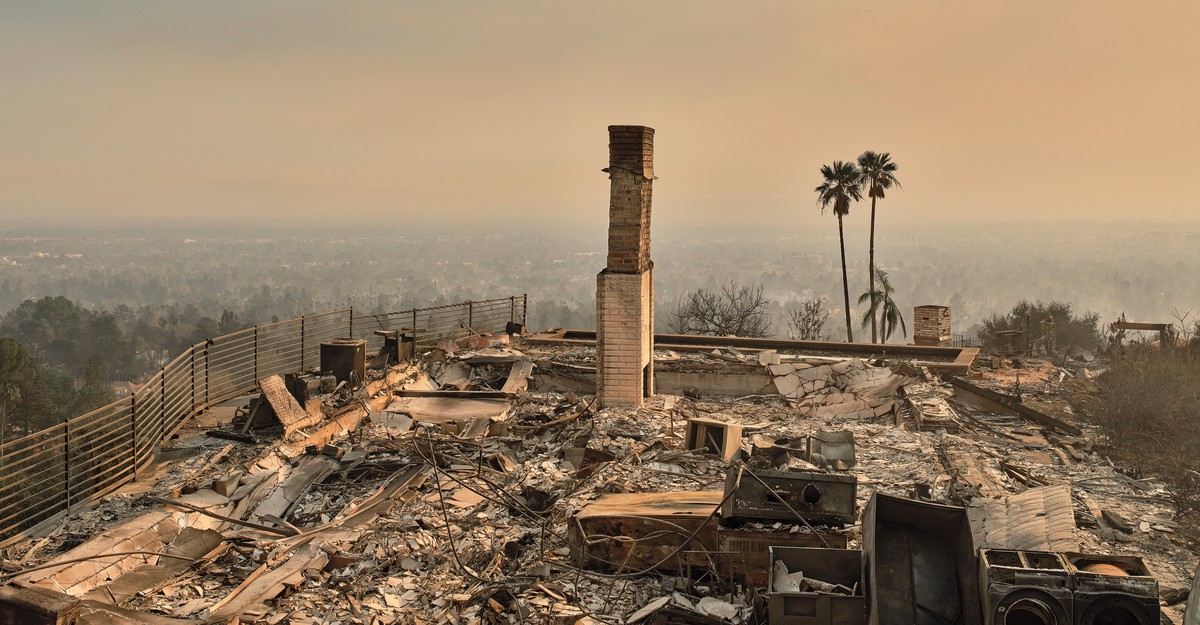
Many places may become uninhabitable. Many people may be on their own.

www.theatlantic.com
I didn’t make up the problems,” Butler
wrote in an essay for
Essence in 2000. “All I did was look around at the problems we’re neglecting now and give them about 30 years to grow into full-fledged disasters.” That same year,
she said in an interview that she dearly hoped she was not prophesying anything at all; that among other social ills, climate change would become a disaster only if it was allowed to fester. “I hope, of course, that we will be smarter than that,” Butler said six years before her death, in 2006.
What will our “full-fledged disasters” be in three decades, as the planet continues to warm? The year 2024 was the hottest on record. Yet 2025 has been perhaps the single most devastating year in the fight for a livable planet. An authoritarian American president has pressed what can only be described as a policy of climate-change acceleration—destroying commitments to clean energy and pushing for more oil production. It doesn’t require an oracle to see where this trajectory might lead.
Taking our cue from Butler, we would do well today to study the ways that climate change has
already reshaped the American landscape, and how disasters are
hollowing out neighborhoods like the one where Butler is buried. We should understand how catastrophe works in a landscape of inequality.
Over the next 30 years or so, the changes to American life might be short of apocalyptic. But miles of heartbreak lie between here and the apocalypse, and the future toward which we are heading will mean heartbreak for millions. Many people will go in search of new homes in cooler, more predictable places. Those travelers will leave behind growing portions of America where services and comforts will be in short supply—let’s call them “dead zones.” Should the demolition of America’s rule of law continue, authoritarianism and climate change will reinforce each other, a vicious spiral from which it will be difficult to exit.
How do we know this? As ever, all it takes is looking around.
Pace of area’s temperature rise, outpaced in US only by Alaskan Arctic, apparently increased in past five years

www.theguardian.com
(Sounds like I’m on a front line):
The US region called New England is widely known for its colonial history, maple syrup and frigid, snow-bound winters. Many of these norms are in the process of being upended, however, by a rapidly altering climate, with new research finding the area is heating up faster than almost anywhere else on Earth.
The breakneck speed of New England’s transformation makes it the fastest-heating area of the US, bar the Alaskan
Arctic, and the pace of its temperature rise has apparently increased in the past five years, according to the study.
“The temperature is not only increasing, it’s accelerating,” said Stephen Young, a climate researcher at Salem State University, who conducted the study,
published in the Climate journal, with his son Joshua Young.
“It’s really sped up in recent years, which surprised me. Our climate is moving in a new direction, after being relatively stable in the past 10,000 years”.


 themainemonitor.org


 www.offshorewind.biz

 ack4whales.org