Serena Williams has part of it right. There is a huge double standard for women when it comes to how bad behavior is punished — and not just in tennis.
But in her protests against an umpire during the United States Open final on Saturday, she also got part of it wrong. I don’t believe it’s a good idea to apply a standard of “If men can get away with it, women should be able to, too.” Rather, I think the question we have to ask ourselves is this: What is the right way to behave to honor our sport and to respect our opponents?
To recap: The trouble began when early in the second set, Ms. Williams was given a warning for coaching. This one is on her coach: Patrick Mouratoglou was using both hands to motion to Ms. Williams to move forward and got called on it. While it is true that illegal coaching is quite common and that most coaches do it, it’s also true that despite what many commentators have said following Saturday’s events, they are called on it quite frequently and that most of the time, players just shrug it off and know that going forward, they and their coaches now need to behave, because the next infraction will cost them a point. The player is responsible for his or her coach’s conduct. And it is actually irrelevant whether the player saw or heard whatever instructions were given; either way, it is still an infraction.
Ms. Williams was not happy about this warning and let the umpire, Carlos Ramos, know it. So far, not so bad. (It is also common for the umpire to talk to the player first about the coaching — a sort of “soft warning” before the real warning so that the player has a chance to “muzzle” the coach. Had that been done, nothing at all might have followed — but we will never know.)
It was a few games later when matters really escalated. Williams lost her serve at 3-1 up and demolished her racket — an automatic code violation that, because it came on top of an earlier warning, resulted in the automatic loss of one point.
Ms. Williams opted to argue about this: She insisted that she didn’t cheat, she wasn’t coached, and therefore she shouldn’t have been docked. But it doesn’t matter whether she knew she was receiving coaching. She was being coached, as Mr. Mouratoglou admitted after the match, and whether she knew it or not is moot. So at this stage, she had been given a warning — one that couldn’t be dismissed retroactively — and had smashed her racket, an automatic violation. Mr. Ramos, effectively, had no choice but to dock her a point.
It was here that Ms. Williams really started to lose the plot. She and Mr. Ramos were, in effect, talking past each other. She was insisting that she doesn’t cheat — completely believable, but besides the point — while he was making a call over which he, at that point, had little discretion.
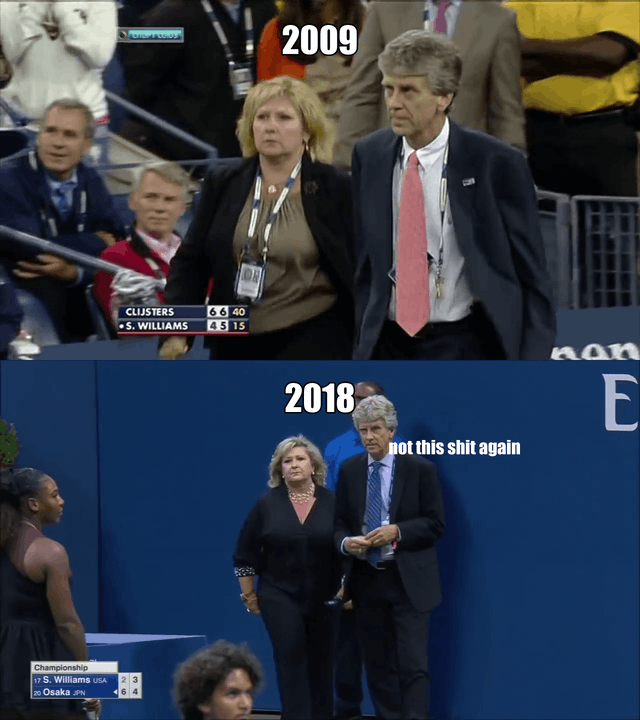
It’s worth noting that Ms. Williams has some serious scar tissue when it comes to this particular tournament. In 2004, she was subjected to some notoriously awful line-calling and umpiring in a match against Jennifer Capriati. In 2009, she suffered a self-inflicted wound when, at match point in a semifinal against Kim Clijsters, she lost her temper at a line judge, leading to a point penalty that resulted in her automatically losing the match. In 2011, in a final against Samantha Stosur, Ms. Williams lost a point for yelling, “Come on!” after hitting a forehand that appeared to help her regain her momentum in a game she’d been losing. She went on to berate the umpire, calling her “unattractive inside,” and was hit with another code violation.
All of this U.S. Open history, combined, perhaps, with always feeling like an outsider in the game of tennis — I know exactly how that feels — goes some way toward explaining why Ms. Williams reacted the way she did, and most of all, how she just couldn’t let go. But what is clear is she could very much not let go.
Much of the coverage has focused on what happened when Ms. Williams confronted Mr. Ramos a second time, demanding an apology and calling him a thief. Mr. Ramos handed Ms. Williams a third code violation — which cost her a whole game. After a long confrontation, play resumed. Naomi Osaka went on to win the match — her first major title, and the first major title for Japan as well — under an onslaught of booing and drama the likes of which, as far as I know, we have never seen in a final of a Grand Slam.
It’s difficult to know, and debatable, whether Ms. Williams could have gotten away with calling the umpire a thief if she were a male player. But to focus on that, I think, is missing the point. If, in fact, the guys are treated with a different measuring stick for the same transgressions, this needs to be thoroughly examined and must be fixed. But we cannot measure ourselves by what we think we should also be able to get away with. In fact, this is the sort of behavior that no one should be engaging in on the court. There have been many times when I was playing that I wanted to break my racket into a thousand pieces. Then I thought about the kids watching. And I grudgingly held on to that racket.
Ms. Williams was absolutely marvelous toward Ms. Osaka after the match. A true champion at her best. But during the match — well, enough said. The way Ms. Osaka carried herself both during and after the match was truly inspiring.
So is there a double standard in tennis?
We do need to take a hard look at our sport, without any rose-colored glasses, and root out any inconsistencies and prejudices that might be there. Tennis is a very democratic sport, and we need to make sure it stays that way.
But it is also on individual players to conduct themselves with respect for the sport we love so dearly. Because we all look so forward to the next time Ms. Williams and Ms. Osaka play each other; hopefully the drama will come from their magnificent shots and their fierce competitiveness — two athletes showing us how it is done, inspiring us all in the process.