
Pearl, I only looked into the thread because I saw you had posted.
I know that you and I both know we are smart and educated guys. So it may come as a surprise to you that I love Bernie (or not, I was always a weird lefty). If you don't mind, I'd like to go a little point by point with you.
Yep, you're right. However, that doesn't mean that tax and wage policy hasn't played a role in the decline of the middle class as a share of the population; it just means that dating it to Reagan is wrong. Below is a graph of the effective and nominal minimum wages historically from the 1930s to 2012.
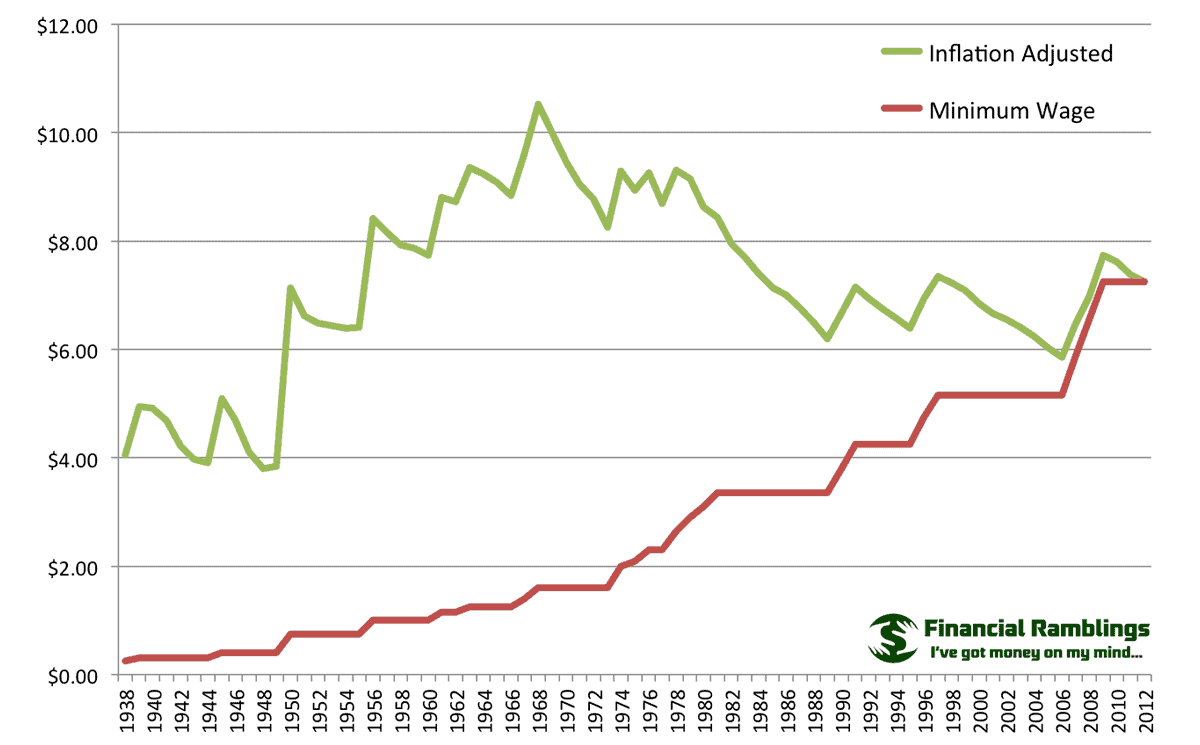
The minimum wage peaked in the late 1960s at an effective rate a little above ten dollars. This also coincides with near historical unemployment lows of 3.4-3.6%.
Unfortunately there's a bit of a tie between two otherwise unrelated issues: those who continually push for lower taxes also tend to push for the abolishment or lowering of the minimum wage. In that sense, I view the Bernie position of a $15 minimum wage as an effective opening bid that might get him a $12 minimum wage. Hillary opens the bid at $12 because, fundamentally, she's actually a conservative.
I also believe there is a strong argument for the provision of increased tax revenues on the backs of the upper 1% (and, BTW, I say this as an individual who stands to pay more taxes in a Sanders administration) and expenditures that increase growth that I will tackle further below.
Narrative plays a large role in politics. However, I don't think the fact that no one has taken action means that there is no link is a particularly valid argument. I'm pretty sure "Congress won't do anything about it, so therefore it isn't real" might be the worst possible argument as it applies to climate change for example. Political problems, almost by definition have particular hurdles that have to be overcome. The hurdle in this instance is overcoming the resistance of the landed elite. It was very difficult to get kings to give up absolute power, but that it took centuries is not evidence that monarchy was a particularly good form of government.
I suspect if you pushed Warren, he would express support for basic income (negative income tax rates) at the low end. Particularly as automation increases. But can you imagine something that would ever be a bigger non-starter for conservatives?
Let me suggest to you my favorite pitch that I developed while watching what happened under the era of real and active sequestration in 2013. There's a dirty secret in this county that Liberals and Conservatives don't like to acknowledge.
The part liberals hate: Our defense budget is strictly necessary for our economy as presently constituted.
The part conservatives hate: The reason our defense budget is necessary is because it is, in effect, the largest jobs program on the planet.
Put simply, way more jobs than anyone realizes depend upon that flow of cash. Engineering firms all but shut up shop during the 2013 sequestration in places like Huntsville, AL and Phoenix, AZ. My own parents moved because the projects that were previously assigned to my father's firm were not renewed by the Department of Defense due to budget cuts. And these are educated people that we want to encourage to have productive jobs in this country.
On the other hand, previous massive government investment creates jobs and externalities in positive and lasting ways. We are still reaping some of the rewards from Roosevelt era programs that created wonderful infrastructure. In the 1960s, 4% of the entire federal budget was dedicated to the space race. NASA employed over 400,000 people and managed to go from nearly nothing to a man on the moon in a decade. If you really think about how astonishing that is, it's simply staggering. Further, the things we learned and developed during that period created a springboard for all kinds of technologies that were not even imaginable in the 1940s. Computing, miniaturization, and materials science lept forward just incredibly rapidly and that technological innovation forms the basis for much of our current wealth. The benefits are both immediate, employing and incentivizing the creation of more trained professionals in the populace, and long-term. It makes everyone richer and gives us all something to believe it that makes it worth it to be American and alive (I'm of the opinion that the lunar lander should be on our $100 bill).
I propose as follows: increased tax revenue from assessments on the wealthy be directly applied, as part of the same bill that raises taxes, to targeted and direct research and development investment in some key areas. Clean energy, space exploration, biotechnology and life sciences, etc etc. A silicon valley approach to expenditure is, in many ways, the cleanest and fastest return on investment we could ever have. And it directly puts people to work. Even if some of those fail, it doesn't really matter. One successful moon shot reaps rewards that are incalculable.
Further, in order to argue that this is good policy doesn't require me to win that this sort of true jobs program would be better than having the private sector spend the same money (although I would take that argument). It only requires me to win that this program would be better than having the top 1% or 0.1% hoard the wealth that they have been accumulating. And I don't think that it's going to take much to prove that hoarding is an inefficient social waste of resources.
TBH: It barely works even if you get a high end graduate degree. My age range has a lot of very indebted doctors and lawyers. For this, I mostly blame US News and World Report, along with no conditional tuition cap as a student loan funding requirement.
The better argument is to displace defense spending with infrastructure and environmental projects such as sustainable energy and desalination. War spending arguably adds zero net long term value to the economy where the alternative projects definitely would. Plus, they tend to be both leading end as well as labor jobs. The nation could benefit a lot from both at this time.


