What's new

Voter Suppression and Why The Republicans Love It So Much?

Obviously, Marx is dead. If he were alive he'd argue with everyone today, and noboddy would be right but Marx.
Agreed.

Anything that makes statements about racial differences and lays out any theorem of guilt or innate unworth of any class, including whites, is racist and hateful.
Also agreed, but that is not what CRT does.
 
One Canadian scholar’s take at what he’s seeing south of his border.


By 2025, American democracy could collapse, causing extreme domestic political instability, including widespread civil violence. By 2030, if not sooner, the country could be governed by a right-wing dictatorship.

We mustn’t dismiss these possibilities just because they seem ludicrous or too horrible to imagine. In 2014, the suggestion that Donald Trump would become president would also have struck nearly everyone as absurd. But today we live in a world where the absurd regularly becomes real and the horrible commonplace.

Leading American academics are now actively addressing the prospect of a fatal weakening of U.S. democracy.

This past November, more than 150 professors of politics, government, political economy and international relations appealed to Congress to pass the Freedom to Vote Act, which would protect the integrity of US elections but is now stalled in the Senate. This is a moment of “great peril and risk,” they wrote. “Time is ticking away, and midnight is approaching.”

I’m a scholar of violent conflict. For more than 40 years, I’ve studied and published on the causes of war, social breakdown, revolution, ethnic violence and genocide, and for nearly two decades I led a centre on peace and conflict studies at the University of Toronto.

Today, as I watch the unfolding crisis in the United States, I see a political and social landscape flashing with warning signals.
Absolutely terrifying but sadly accurate
 
No paywall on this Washington Post piece. Argues that American media must be much more proactive in pointing out how our democracy is endangered…


In the year since the Jan. 6 insurrection, mainstream journalists have done a lot of things right. They’ve published major investigations, pointed out politicians’ lies and, in many cases, finally learned how to clearly communicate the facts of what happened leading up to that horrendous riot at the U.S. Capitol — and what is happening now as pro-Trump Republicans steadily chip away at the very checks and balances that saved American democracy last year.

Much of this work has been impressive. And yet, something crucial is missing. For the most part, news organizations are not making democracy-under-siege a central focus of the work they present to the public.

“We are losing our democracy day by day, and journalists are individually aware of this, but media outlets are not centering this as the story it should be,” said Ruth Ben-Ghiat, a scholar of autocracy and the author of “Strongmen: Mussolini to the Present.”

That American democracy is teetering is unquestionable. Jan. 6 is every day now,in the words of a recent New York Times editorial that noted the growing evidence: election officials harassed by conspiracy theory addicts, death threats issued to politicians who vote their conscience, GOP lawmakers pushing measures to make it harder for citizens to vote and easier for partisans to overturn legitimate voting results.

“The reactionary counter-mobilization against democracy has accelerated,” wrotehistorian Thomas Zimmer, a visiting professor at Georgetown. “It’s happening on so many fronts simultaneously that it’s easy to lose sight of how things are connected.”
 
No paywall on this Washington Post piece. Argues that American media must be much more proactive in pointing out how our democracy is endangered…


In the year since the Jan. 6 insurrection, mainstream journalists have done a lot of things right. They’ve published major investigations, pointed out politicians’ lies and, in many cases, finally learned how to clearly communicate the facts of what happened leading up to that horrendous riot at the U.S. Capitol — and what is happening now as pro-Trump Republicans steadily chip away at the very checks and balances that saved American democracy last year.

Much of this work has been impressive. And yet, something crucial is missing. For the most part, news organizations are not making democracy-under-siege a central focus of the work they present to the public.

“We are losing our democracy day by day, and journalists are individually aware of this, but media outlets are not centering this as the story it should be,” said Ruth Ben-Ghiat, a scholar of autocracy and the author of “Strongmen: Mussolini to the Present.”

That American democracy is teetering is unquestionable. Jan. 6 is every day now,in the words of a recent New York Times editorial that noted the growing evidence: election officials harassed by conspiracy theory addicts, death threats issued to politicians who vote their conscience, GOP lawmakers pushing measures to make it harder for citizens to vote and easier for partisans to overturn legitimate voting results.

“The reactionary counter-mobilization against democracy has accelerated,” wrotehistorian Thomas Zimmer, a visiting professor at Georgetown. “It’s happening on so many fronts simultaneously that it’s easy to lose sight of how things are connected.”

I think this line of scholarship is ridiculous.

First of all, the Civil War ended one of the most important features of the original constitutional system, the sovereignty of states in a federal scheme that depended on local power to balance national power. "Democracy" is local. Any time you have some faraway honchos making decisions for people against what those people would support locally, you have replaced democracy with tyranny.

Secondly, with the "Robber Barons'" ability to buy influence, democracy has been decimated. The true "progressive" movement of the 1890s to 1920s attempted to curtail that power of interests over democratic representatives, both R & D. It was not a well-organized movement, and European meddlers pushing Brit-backed global schemes got in the mix, and used it to insinuate all kinds of centralized programs that could not really fit with the original Constitution. It all added to central power and reduced local control or democracy.

The thesis that all democracy is local contains the notions of individual rights, and that strong local governance that is closer and more accountable to the people is a value that trumps expertise operating in central government offices. Basically, if you can't smell the garbage at hand, you've got no business in it.

globalization, in this light, is antithetical to democracy.

Globalization is essentially a Brit operation, a new sort of pretend democracy, that enables the "Masters" to manipulate everything, everywhere, mostly influenced by interests. It is Fascist.
 
Last edited:
First of all, the Civil War ended one of the most important features of the original constitutional system, the sovereignty of states in a federal scheme that depended on local power to balance national power. "Democracy" is local. Any time you have some faraway honchos making decisions for people against what those people would support locally, you have replaced democracy with tyranny.
Federalism doesn't give states the right to secede from the constitutional system if they wish.

What's hilarious about this whole local control vs federal control is that historically in this country, state or local control has led to far more tyranny, violence, and death than federal control. Slavery, Civil War, Jim Crow, and the current tyranny of gerrymandering and overthrowing election counts all stems from the tyranny of local control.

Literally, local control enabled slavery to flourish. Individual rights were trampled because of local control. Do rights to treat blacks as merely property exist because local governments say so?

You're being a hypocrite here. If local control supersedes federal control, why did slave owners push for the Fugitive Slave Act? This forced free states to return runaway slaves to slave states. Why did southern slave owners celebrate the Dred Scott Decision, which gave the federal government control to force freedmen back into slavery even if their owners moved to a free state? "lOcAl cOnToL" right?

Secondly, with the "Robber Barons'" ability to buy influence, democracy has been decimated. The true "progressive" movement of the 1890s to 1920s attempted to curtail that power of intere4sts over democratic representatives, bothR & D. It was not a well-organized movement,and European meddlers pushing Brit-backed global schemes got in the mix, and used it to insinuate all kinds of centralized programs that could not really fit with the original Constitution. It all added to central power and reduced local control or democracy.
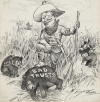
This is a weird claim to make, especially since Roosevelt was hated for waging wars against Robber Barons/trusts.
1641231832691.png
How else can multi-state and international businesses be broken up or regulated if not by a centralized government agency? Local control proved to be ineffective against the rise of Robber Barons, hence why progressives acted to do something about it.

The thesis that all democracy is local contains the notion of individual rights, and strrong local governance that is closer and more accountable to the people.
That's a weird definition of democracy. We have centuries now of individual rights being trampled by local governments. Hence, why the Civil War even started.

globalization, in this light, is antithetical to democracy.

Globalization is essentially a Brit operation, a new sort of pretend democracy, that enables the "Masters" to manipulate everything, everywhere, mostly influenced by interests. It is Fascist.
Turn off 8chan. Brit operation? lol.

I'd love to know how Trumpers think we can end Globalization in America. Like let's just make them kings for one day. How do you end Globalization?

I love how cheap my Iphone is. It would cost thousands more to be made here. The minerals needed to manufacture one aren't found in America either. So I guess I'd give up my cheap IPhone?
I love my Toyota car. It's really dependable. So I guess I'd have to buy some crappy domestic one?
I love tropical fruits from South America. So I guess I'd have to give those up for fruits that can be made here?
I love chocolate. Can cocoa beans be grown here? So I guess I'd have to give chocolate up?
I love American allies and alliances that have kept the west safe since WWII. If we give up our alliances will we go back to individual countries waging war against each other? So could we see Germany wage war against France or Russia again? How about Spain vs the UK?

And if we give all of that up, our lives are supposed to be better off? How?
 
Last edited by a moderator:
Slavery in America evolved along with other forms of servitude, such as the apprenticeship system in european guilds. A lot of people came here on the system of seven years, or whatever time, in exchange for paying for the trip and most living expenses while learning the new place and a new trade. Labor was needed, people were desperate to get it. I think it was mostly British ships that brought the slaves here. That trade created a "market" for captured people from Africa, which was supplied by locals who could exercise that power over others. Slavery was never "local". Some states had religious settlement originally that didn't believe it doing that, and these states gave care for escaped slaves generally.

I really don't know much about slavery, aside from being something of wage-slave myself sometimes. Which is like nothing compared to the reality of being a slave in America. Treatment varied a lot. One obstacle to just giving a slave liberty was no support system readily available. No jobs with a wage in that area, no home, and no community, stuff like that. So a lot of slave-holders were somewhat "trapped" in holding slaves. Some of these more conscientious people tried to treat the slaves better, but often faced recrimination if they did.

The thesis I advanced that "democracy is local" pertains to a situation where people have some essential rights and a culture that support certain liberties. It contains the notions of equality of people under the law, equal treatment in the culture. Obviously, a class of people, like the native Americans or other races which were routinely denied their human rights is not what I am saying.

You have no real evidence in any kind of well-studied report about the distinctions of local vs state or federal incidence of corruption and cronyism. It is a universal problem with human nature, but if the problem is localized, people can address it locally if they will. If it is happening thousands of miles away in a bureaucracy that nobody can track, there's little you can do. If you elect a congressman, a senator or a President who wants to do something about it, he is outflanked, outnumbered, and derailed by the crooks quite easily.

If your vote becomes worthless because of a system like this, it is not "democracy" at all.
 
The Civil War did not end state's rights. The supremacy clause has always existed. The Civil War made clear that 1) states did not have the right to enslave their fellow humans, which was the primary issue leading to the war and 2) states could not secede from the union in order to keep slavery legal.

The Civil War was about slavery. That's the "State Right" in question. There was no broader ideological movement regarding State's Rights involved. To claim otherwise is absolute revisionist history.

babe just had the good sense to make an argument that there was nice slavery and not quite as nice slavery and so it was more complicated than just saying the keeping humans as slaves is wrong. Ahh babe.
 
I really don't know much about slavery
I stopped right here. And honestly, that’s probably all you needed to write. You should probably learn about the topics you want to discuss.
 
The Civil War did not end state's rights. The supremacy clause has always existed. The Civil War made clear that 1) states did not have the right to enslave their fellow humans, which was the primary issue leading to the war and 2) states could not secede from the union in order to keep slavery legal.

The Civil War was about slavery. That's the "State Right" in question. There was no broader ideological movement regarding State's Rights involved. To claim otherwise is absolute revisionist history.

babe just had the good sense to make an argument that there was nice slavery and not quite as nice slavery and so it was more complicated than just saying the keeping humans as slaves is wrong. Ahh babe.
Don't be an idiot. People are always gonna be people, and always with some degrees of attitudes and manners of difference. Saying there are variations in how people act within societies or systems is virtually impossible to deny, except that when critics call out a society or a race, the rhetoric generally takes on aspects of hate speech, and the critics imply people are all bad or all good.

I could also argue that there were good slaves and bad slaves in various respects. It's like saying there are good bosses and bad bosses, good workers and bad workers. People cope. In any situation, in every circumstance, in every kind of government, in every religion, in every science, in every activity;. It's a survival mode. When you can't change things, you cope.

So black conservatives tend to speak more harshly against slavery than white liberals, did you notice?

But they are decrying the system more than the people who were in it, the institution more than the humans. And then they hoot about why reparations are nonsense, and how they have everything they need to succeed They are painting a pc of how despite the worst. the world or people can do, they don't have the attitude of being a victim. Times have changed. People changed things. Almost everybody changed. Now they have liberty and they are not about to let the stupid fascist globalist/Democrat cronys take it and make them slaves to socialism. Or communism.

Remember how many times I've said that as an ideology, nobody who is anybody really significant, especially the likes of Obama or Hillary, really believe in the ideas? They use the ideas. They are corrupt as hell, and bent on taking advantage of people to their own enrichment.

I could throw in McConnell too. And Pelosi.

These folks are tyrants, and they want the power.
 
The Civil War did not end state's rights. The supremacy clause has always existed. The Civil War made clear that 1) states did not have the right to enslave their fellow humans, which was the primary issue leading to the war and 2) states could not secede from the union in order to keep slavery legal.

The Civil War was about slavery. That's the "State Right" in question. There was no broader ideological movement regarding State's Rights involved. To claim otherwise is absolute revisionist history.

babe just had the good sense to make an argument that there was nice slavery and not quite as nice slavery and so it was more complicated than just saying the keeping humans as slaves is wrong. Ahh babe.

Lincoln was tapped for the Republican ticket by a group of bankers who intended to split the country. They thought Lincoln was the dupe for the day. For years, British agents and their banking cronies had bankrolled abolitionists and secessionists alike, often exploiting local Masonic lodge networks of like-minded dupes. When the breakup began, they had surrounded Lincoln with their advisors who all said "Just let them go". But they should have checked out Lincoln's character a little better. He clearly saw that if the Union broke apart, the pieces would be run over by European interests if not armies. He figured the only chance America as an idea of a government owned by the people could stand in this world, is we stuck together.

He didn't believe in slavery in the least, but he believed in the Union more than anything. The South was babbling about States' Rights, not about the slaves when they formed up their ranks. Some slave states did not join. Lincoln excepted those from the 1/863 proclamation, which in specific terms only applied to the rebel states.

Look, slavery could not have lasted, war or no war. Machines were coming, the slaves would hardly be economical when the farm machinery was available. Yes, many northern soldiers believed they were fighting to free the slaves. And the popular voice of Americans was heavily going towards ending slavery.

It took the Democrat Party to keep the race issues going after the war. Good ol southern democrats, clear up to Senb Byrd and Sen. Fulbright.

Exploiting local issues and dividing people of another nation or place has always been the British way to manipulating everything.
 
I stopped right here. And honestly, that’s probably all you needed to write. You should probably learn about the topics you want to discuss.

You don't know anything about it either. I was not a slave, I didn't live through any of that. If you have believed what you read, you probably won't get the picture. I mean, you definitely don't know much

Everyone who writes about stuff they don't know could just as well qualify their remarks with that confession..

But hey, being on chat discussion is equivalent to conessing ignorance People gotta talk, and for whatever it's worth, learn something from other people.

I understand David Webb on XM125 has been discussing a book about black history that tries to stick to the facts. I've heard a few of the sessions, and it is clearly much better than I know. It's a big book written byh two college professors who've spent their lives studying the history.

 
Back
Top