What's new

Evolution discussion

I found this amusing evolution chart:
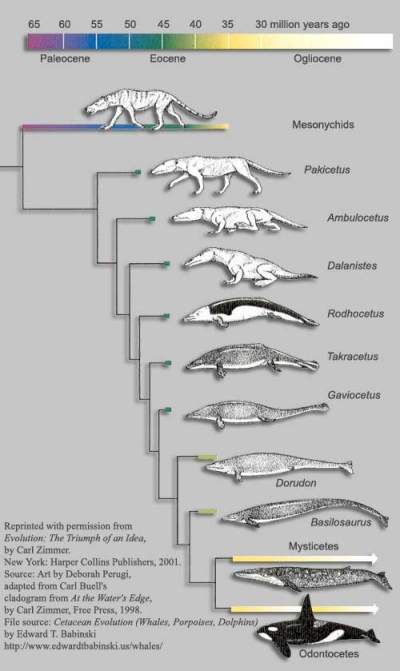
2188684_1a66a783-68ed-4e52-a775-d113d532e522_prod.jpg
 
I had to find the fake linear progression chart myself since you refused.

whales-graph.jpg


See how clean and well organized that sequence is.

All that Darwiniac effort spent piecing that together was wasted on supporting a designed progression. If all the fossils they find fit into the progression nicely where are all the "unfit" retarded babies that nature rejected?
 
The current evidence is that whales have a much more recent common ancestry with hippos than with bears, and hippos also have legs.

So the hippo was just one of the retarded babies of the pakicetus and the indolyus that managed to survive? The other retarded baby went on to make the dolphin and the whale somehow.

whale_evo.jpg


Where did the idolyus come from? Just curious.
 
See how clean and well organized that sequence is.

Obviously as it is humans ( evolutionists) who put those pieces of the puzzle together. And you just confirmed it here:

All that Darwiniac effort spent piecing that together was wasted on supporting a designed progression. If all the fossils they find fit into the progression nicely where are all the "unfit" retarded babies that nature rejected?

So you again agreeing with evolution but only disagreement you make that somebody was designing it? Have it not crossed your mind that what you call "unfit retarded babies" are in this chart up till the end?
So again, lets be clear - you agree that whales evolved from pakicetus/indionyhus, ambulocetus and so on... you believe though that it was not by evolution laws/principles throughout millions of years but by rather by "some intelligent designer" manipulating those "unfit retarded babies" and molding them to his liking until he created whale? Am I right?
 
Here's my take and what I understand about evolution:

Individual species do show a capability and proclivity to adapt to their surroundings, and an argument can be made that they "evolve" over time. However, as advanced geneticists will tell you, there is a genetic boundary between one species and another. That is, there is a physical limit to the degree that a species can change, over time or via direct hybridization experiments.

So while Darwin's thesis that species will adapt to improve their survivability is valid, there is genetic evidence within and between defined species that belie the claim that one species can transform itself into another altogether. Hence, the hypothesis that 'evolution' can account for the origin of multifarious species through transmutation--a single-celled organism ultimately becoming a monkey, then a human--is not supported by modern biology and genetics research.
 
I'll add a bit more....

Darwin put forward two theories really, one being 'natural selection' (that species adapt in favor of certain useful traits they have, or risk extinction), and the other being 'common ancestry' (that all species have a common origin or ultimately common ancestry, that all living creatures essentially comprise a single family tree of sorts). Both theories were put forth 150 years ago. The latter, in particular, could not be proven at the time, and has not been proven since. So it remains a theory or, for some, a simplistic paradigm by which to compare one species to another.

'Common ancestry' does not gain support from archeological evidence that documents the existence of certain species (including mankind) long before Darwin theorized that such species could come into existence by way of evolution. At the same time, there are significant gaps (or dramatic changes) between species with no forensic evidence of an intermediate step--that is, physical evidence that one species progressively evolved into another, let alone considering the date and geographic location that such intermediate organisms should be found. Add to it discovered evidence of life and conditions for life on other planets, and Darwin's 'Origin of Species' unravels quickly. And that's just looking at things from the perspective of physical science.

Trying to use evolutionary biology to explain the development of the human mind, of human language and culture, of philosophy, of literature, of art and music, and of science itself is also problematic.
 
Here's my take and what I understand about evolution:

Individual species do show a capability and proclivity to adapt to their surroundings, and an argument can be made that they "evolve" over time. However, as advanced geneticists will tell you, there is a genetic boundary between one species and another. That is, there is a physical limit to the degree that a species can change, over time or via direct hybridization experiments.

So while Darwin's thesis that species will adapt to improve their survivability is valid, there is genetic evidence within and between defined species that belie the claim that one species can transform itself into another altogether. Hence, the hypothesis that 'evolution' can account for the origin of multifarious species through transmutation--a single-celled organism ultimately becoming a monkey, then a human--is not supported by modern biology and genetics research.

Can definitely have a conversation about the concepts of evolution if you wish, since you don't seem to refuse to understand the 2+2=4 parts of evolution and using that to try to argue the non-existence of the quantum physics part of evolution.

To accurately define things like natural selection, you have to accurately define evolution. The definition is very simple. Evolution is the change in gene frequencies in a population over time. What does that mean exactly? Well, a change is simply a percentage. 30% of this allele to 70% of that allele, to make it simplistic goes to 35-65% over the course of, say, five generations. And take note, this includes the entire genotype, and not just the phenotype. Genotype is the entire genetic code, while phenotype is just the physical, observational traits. A population is a group of organisms willing and able to reproduce. So if that population changes, either with the addition of a separate, compatible population, or a separation of one population into two, through environmental or social causes, the population has changed, and thus the gene frequencies will have changed.

Natural selection is the most talked about element of evolution, and it is the most common driver of evolution. It's also one of the most obvious logical statements when you actually look at it. Basically, natural selection states that the genes in organisms that reproduce tend to last longer than genes in organisms that don't reproduce. Natural selection doesn't really affect genes that aren't part of the phenotype, since the concept is about how organisms over time are influenced by the environment, physically and behaviorally.

As far as speciation goes, and then moving into wide reaching evolutionary process, the definitions start getting a bit hairy since there's no good way to define species. From a simplistic standpoint, speciation is when two previously compatible populations no longer are able to produce viable offspring able to reproduce, when one species becomes two, given the latter part of the definition is a common way to define species. This is easy enough when dealing with tremendously complex organisms. Humans and chimps can't reproduce, thus are different species. Labradors and German Shepherds can reproduce, so they're the same species. The problem is multi-fold. First, mankind has a need to compartmentalize. This is different from that. This is not as different from that as that over there, etc. The idea of species and classification of them was started at the top, most complex side, and the definition of species and similar terms that work with complex organisms do not work as well, or not much at all when dealing with asexual prokaryotes and eukaryotes.

In any event, populations that branch and lose contact with other populations of the same species, can and will, over time, due to a wide range of evolutionary factors, become diverse and distinct enough to share a vast amount of genetic data but have that "genetic boundary" you mentioned when comparing the two populations synchronically after the two populations have evolved past the point of being the same species.
 
Whoooooo?

Birds.

I wouldn't call 20% all.

I don't think 20% of fossilized species are extant, either.

I love how you just fling out crazy *** statements willy nilly.

You agree an rose always seeds roses, and amoebas always reproduce amoebas, right?

PW: There were black and white moths before pollution and there was black and white moths after.
OB: Of course.

When you are trying to show that black moths are more "fit" for survival than white, the continued existence of white moths presents a huge problem.

More fit relatively, not absolutely.

PW: If you continued to support this idea that nature knows how to deal with pollution you would also undermine the entire "climate change" movement. Ooops.
OB: I don't see the connection between the peppered moth experiment and "nature knows".

If "natural selection" of black moths leads to adaptation to pollution. What other crazy *** **** does mother nature perform to adapt to human caused pollution. It turns out she has a lot of tricks up her sleeve, like sea bacteria that eats oil slicks.

There is a huge about of variation, and nature does have all kinds of tricks up her sleeve. However, that doesn't mean nature can adapt to every contingency. Oil still wreaks havoc on land and in fresh water. No plant ever developed a resistance to Agent Orange. Smallpox was wiped out because it couldn't adapt. 99% of all species went extinct even before there was pollution.

The real problem is that scientists can't question the crazy *** answers Darwiniacs insist upon.

The real problem there is that the scientists you are talking about don't have good arguments or reliable evidence to question the answers of MET.
 
and you Darwiniacs must have a chart somewhere that shows the progression from pakicetus to whale...that would be a linear progression....you get what I'm saying?

Have you ever taken geometry?

A chart is a simplification of a complex process. It doesn't present the whole story. The full linage of any ancient species with modern descendants would have hundreds of branches, most of which terminate.
 
At the same time, there are significant gaps (or dramatic changes) between species with no forensic evidence of an intermediate step--that is, physical evidence that one species progressively evolved into another, let alone considering the date and geographic location that such intermediate organisms should be found.

What are you talking about? There is thousands of fossils of transitional species and there is numerous living animals now which can be regarded as transitional species. You again making same mistake as numerous evolution deniers are making - since it can't be observed within our lifetime it must be wrong. Think about how short humanity's history is compared to billions of years of evolution. Think how much environment and climate including such important thing as oxygen levels and temperature changed throughout Earth history and imagine it's influence on all living beings.I am not even talking about ice ages or meteor's hitting Earth and creating havoc.
 
Back
Top