What's new

Evolution discussion

Individual species do show a capability and proclivity to adapt to their surroundings, and an argument can be made that they "evolve" over time. However, as advanced geneticists will tell you, there is a genetic boundary between one species and another. That is, there is a physical limit to the degree that a species can change, over time or via direct hybridization experiments.

There is a limit to the amount of change possible *within* a given time frame. It's ludicrous to think the limits we see in 100 years of experimentation are the same as the limits for a million years of evolution.

So while Darwin's thesis that species will adapt to improve their survivability is valid, there is genetic evidence within and between defined species that belie the claim that one species can transform itself into another altogether.

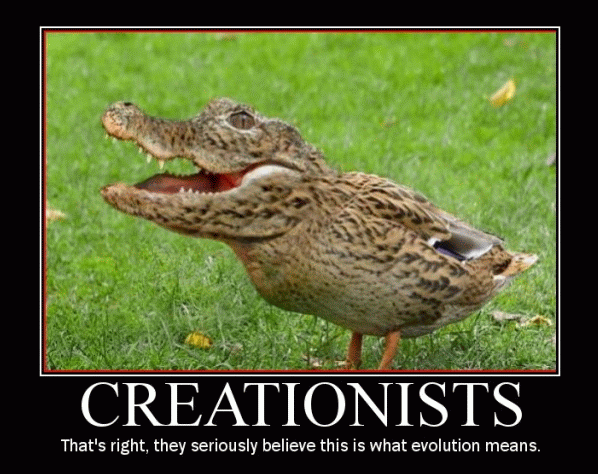
Evolution does not teach that one species transforms itself into another. That's a crocoduck.
 
The latter, in particular, could not be proven at the time, and has not been proven since. So it remains a theory or, for some, a simplistic paradigm by which to compare one species to another.

The word "theory" is used for the best-evidence, most-reliable explanations of science. Nuclear physicists refer to atomic theory, not because they are unsure atoms exits, but because they are sure atoms do exist. Geologists refer to plate tectonic theory, not because they are unsure that the continents are floating, but because they are sure that they are. Biologists refer to evolutionary theory because they are sure it is true.

'Common ancestry' does not gain support from archeological evidence that documents the existence of certain species (including mankind) long before Darwin theorized that such species could come into existence by way of evolution.

Really? You know of archaeological evidence that is over 100,000 years old? Please link to it. I have to see this.

At the same time, there are significant gaps (or dramatic changes) between species with no forensic evidence of an intermediate step--that is, physical evidence that one species progressively evolved into another, let alone considering the date and geographic location that such intermediate organisms should be found.

Of course there are gaps, and will always be gaps. In fact, when we find a fossil B that fits into a gap between A and C, that fossil creates two new gaps (one between A and B, the other between B and C). Sure, these gaps are smaller, but they're still gaps. Scientists are busily creating brand-new, smaller gaps all the time.

Add to it discovered evidence of life and conditions for life on other planets, and Darwin's 'Origin of Species' unravels quickly. And that's just looking at things from the perspective of physical science.

There has been no reliable evidence on life on any non-Earth body.

Trying to use evolutionary biology to explain the development of the human mind, of human language and culture, of philosophy, of literature, of art and music, and of science itself is also problematic.

If it wasn't a problem, no one would study it.
 
Can you show the progression from rib to human and show us your sciency knowledge?

Okay, I can do this sciency stuff I learned from watching you Darwiniacs.

Assume an Adam-like ancestor. One day it randomly mutated boobs, uterus, Fallopian tubes, ovaries and walah you have yourself an Eve species.

Your type of "science" is so damn easy even a God believer could do it. You just pick a starting point, and select the desirable mutations and then you explain it all to the good little school children.
 
Okay, I can do this sciency stuff I learned from watching you Darwiniacs.

Assume an Adam-like ancestor. One day it randomly mutated boobs, uterus, Fallopian tubes, ovaries and walah you have yourself an Eve species.
.

You are making same fundamental mistake all creationists make. One day random mutation has nothing to do with evolution which took place in millions of years. Don't be silly, seriously. Plus Adam like ancestor had no mate to produce any "mutated retarded babies";)
 
Love this quote:

"We thus come to the final and most troubling question of history: the why? Why did the history of life unfold as it did? From the time of Darwin all the way until today there remains a group of nonscientists who find little trouble in answering this question: it has been God’s will. But for those who choose to follow the methodology and philosophy of science, the why question concerning the history of life has been most troubling.

so again, it all comes down to simple confrontation - one group who does not bother to understand and look for answers and instead simply trying to blame "God's will" for everything. And other group which tries to learn and understand. To me chosing to support first group is loser's mentality and giving up. I want to learn and know. Trully feel sorry for those who give up.
 
OB: There is an entire field of evolutionary design and programming that contradicts this. You set up a few conditions that determine success and some basic starting point. You repeatedly generate a couple of thousand designs with small, random changes (random variation) and then pick out the ones the best fit the criteria (natural selection). You keep repeating this until you get the behavior you want. Among other things, I recall there was an antenna designed by this process, one that looked nothing like any previous antenna designed by humans, that worked better than a human-designed antenna.
PW: Not contradictory at all. You know that part "you set up a few conditions" and "You repeatedly generate" and "You keep repeating"...that's the intelligent design part.
OB: In nature, the environment sets up the conditions, without intent or intelligence. Reproduction creates the new generations, without intent or intelligence. Selection occurs, without intent or intelligence. So, if you acknowledge evolutionary design is possible at all, denying evolution in living things is self-contradictory.​

Okay, let me explain this a different way.

Your comparison isn't meaningful. You can't compare "natural" (undirected) selection to "you pick out the ones that best fit your criteria" (directed) selection.

Evolutionary Design=Intelligent Design because Intelligent Design = Directed Selection

If we apply it to real world study

Selective Breeding=ID
*********
PW: Think of specified as useful patterns. The sculpted rocks of Mt. Rushmore may not have a use besides tourism, but the faces they were copied from do.
OB: Nice try to divert the topic. However, the Man in the Mountain also had an eye, nose, etc. Again, we know one was designed, and the other not, by the simplicity in the designed monument.​

It ain't a diversion. Mt. Rushmore has always been a representation of the biological systems we are really talking about. The eyes on Mount Rushmore lack one important feature that biological eyes have. Usefulness.
**********
PW: Under your random/accidental system there is no reason to expect that the first place our eyes appeared were on the front of our faces. Why don't we have ancestors with eyes at the end of each boob or knee? or on the back of their heads? The existence of clunkers like that would really lend some credibility to your crazy *** theory.
OB: Actually, it would undermine it. Eyes developed long before long before boobs and knees.​

Oh right. Fish have two eyes. But the first known creature to have eyes had 5 eyes. Why did 3 eyes disappear once it mutated its way into the fish? I would guess 5 eyes would make any fish more fit.

*********
PW: But seriously, you seem to be implying that any existence of "flaws" in the system negates intelligent design. The only thing "flaws" negate are purity/perfection in the design/useful pattern.
OB: Most ID advocates not not seeking to put forth the Incompetent Designer. I fully acknowledge that if you think life might have been designed by an Incompetent Designer or a Malicious Designer, than the inferior construction of living things is no bar. However, since either of those designers is consistent with any state of affiars, they can not be evidenced, either.​

Actually, the Christian dogma behind The Designer is that there must be "flaws" in the design from the start or some way for "flaws" to enter the system along the way in order for humans to experience difficulties and eventual death.
I assume the original DNA code for humans was more pure so insulin resistence (<---the thing that causes "aging") took more time, so our early ancestors had longer life spans.
********
PW: Formula (*) asserts that the information in both A and B jointly is the information in A plus the information in B that is not in A. ... Either way. If you have 2 seperate books with the same story or if there are two copies of the story in one book the formula accounts for both.
OB: What the formula does not account for is the processing environment. If program A has output B in some computing environment X, it may have an entirely different output C in computing environment Y. It's not just A that contributes to B, it's both A and X. As such, B can have information derived from X that is does not exist in A, and may even have information that is not present in A or X alone, but only when the two are joined together.
The formula is just wrong in saying that laying two copies of at text, end-to-end, produces no new information. Every measure of information in use says the amount of information increases.​

The processing environment is a different story...haha...but computer programs are fully deterministic so B is fully determined by A.

The amount of information may increase but the amount of new information doesn't. There are more pages in the 2 copy book but you can't learn anything more from reading the second copy of the story than you did from reading the first copy of the story.

Remember we are talking about the ability of undirected contingencies (chance) to create new information.

Formula (*) asserts that the information in both A and B jointly is the information in A plus the information in B that is not in A. Its point, therefore, is to spell out how much additional information B contributes to A. As such, this formula places tight constraints on the generation of new information. Does, for instance, a computer program, call it A, by outputting some data, call the data B, generate new information? Computer programs are fully deterministic, and so B is fully determined by A. It follows that P(B|A) = 1, and thus I(B|A) = 0 (the logarithm of 1 is always 0). From Formula (*) it therefore follows that I(A&B) = I(A), and therefore that the amount of information in A and B jointly is no more than the amount of information in A by itself.​

*********
PW: You notice how you had to add an intelligent force into the equation ("you") in order to produce useful information. Same thing holds true for all of our biological parts/systems.
OB: I fully acknowledge that the division algorithm is a designed process. However, my point was that you can't claim that something is not produced by a process simply because it is not produced in any particular step. This is just as true of useful information as it is of division.​

I don't believe I ever made that claim, so your point is moot.

We were talking about "Whenever chance and necessity work together..." they can't create new useful information.

********
OB: Yet, the two copies laid end-to-end still has more information.
PW:... your conclusion hasn't been backed up with logic.
OB: It's very basic information theory. 01100110 has more information than 0110. 0110011001100110 has still more.​

Again, there may be more information but not new information.
********
PW: I don't think it was useful...
OB: It served, and still serves to some degree, the same purpose as Mt. Rushmore.​

Yes, it served as something to look at with our real eyes. Too bad that point was just as useless as the mountain eyes.
*******
PW: That is one of the most bizarre answers I've ever seen...it is like a 50 ft. wookie.
OB: Yes human language changed over time but it originates from an intelligence source...the human mind...are you really going to deny that humans are intelligent beings?
Who directed the changes? ID is not just a claim of intelligence, but one of intelligent direction. There was no one person or group who directed the change from Old English to Middle English or Latin to Romanian. Everyone just spoke the language they learned, with small differences due to their own particulars and peculiarities (random variation). The variations that were pick up by others (reproduction) either were preserved or let go (selection). No one decided which changes to make.​

ID scientists ain't claiming that the direction of change is from complex to simple.

What you are talking about is entropy of a system.

Human's made an alphabet (symbols of sounds) and created words (more complex sounds) and then strung those words together to make sentences and so forth. Then over time the language changed a little bit here and there but it was still recognized as language...and was useful for the transfer of information between humans.

This is why you can't apply "micro-evolution" to Darwin's common ancestry theory, because it is just change in creatures that already exist. It doesn't account for how those creatures came into existence.
*******
PW: The appendix was more useful hundreds of years ago when we weren't city dwellers.
OB: How so? Not everyone today is a city dweller or has significant city-dweller ancestry. Are you saying their appendixes work differently?​

I'm saying depending on the environment the usefulness of the appendix changes. This is what us God-believers call adaptability.
*******
PW: So in conclusion all your "vestigial" arguments are as useless as your stories about bears falling into the ocean and becoming whales.
OB: So, you think is an organ has any sort of use at all, no matter how poorly done, duplicated, and inefficient it is at that task, it's not vestigial? I don't think you understand the term.​

No, I think "vestigal" organs don't serve your fish to human claim, just your ape-like ancestor claim.

But if it supports your ape-like ancestor assumptive starting point it also supports the Bible's Adam starting point. So you unwittingly support the "creationists" you despise.
 
You are making same fundamental mistake all creationists make. One day random mutation has nothing to do with evolution which took place in millions of years. Don't be silly, seriously. Plus Adam like ancestor had no mate to produce any "mutated retarded babies";)

I ain't making a mistake. The uterus, fallopian tubes, and ovaries all had to appear simultaneously to be useful for sexual reproduction. If you take any one of those parts away, there is no sexual reproduction. (This is what Behe was trying to tell you)

If they evolved separately then what made them more "fit" for survival?

If our asexual ancestor just mutated a fully formed egg sac one day they would still be no closer to the ability to sexually reproduce...and thus no more "fit" for survival than they already were just making copies of themselves.
 
Okay, I can do this sciency stuff I learned from watching you Darwiniacs.

Assume an Adam-like ancestor. One day it randomly mutated boobs, uterus, Fallopian tubes, ovaries and walah you have yourself an Eve species.

Your type of "science" is so damn easy even a God believer could do it. You just pick a starting point, and select the desirable mutations and then you explain it all to the good little school children.

Better watch out. Crocoduck will happen at any moment.

cod.gif
 
In any event, populations that branch and lose contact with other populations of the same species, can and will, over time, due to a wide range of evolutionary factors, become diverse and distinct enough to share a vast amount of genetic data but have that "genetic boundary" you mentioned when comparing the two populations synchronically after the two populations have evolved past the point of being the same species.

What you've described makes some sense, and it follows plausible logic. Basically, you're saying that if a species evolves to a certain point via a process of genetic transmutation it might not be able to (or need to) evolve/mutate much further, and moreover the process of genetic transmutation the species has experienced may not be reversible.

However, such a theory fails to take into account a few valid and significant bodies of evidence that indicate:

1) Certain species, most notably mankind itself, did not come into existence at the time that Darwin proposed in his theory. There is compelling physical evidence that advanced human civilizations existed on multiple continents (and on land masses now submerged) hundreds of millions of years ago. This is before such genetic and cultural development would be plausible or even possible had mankind systematically evolved from other 'apelike' organisms. In other words, mankind made his entrance on the world stage and became civilized too early to have developed along Darwin's proposed evolutionary time scale.

2) If you accept the theory that mankind evolved from an organism in Africa now euphemistically called the "missing link" (between man and a type of ape) you would need to accept that ALL human beings ultimately are descended from that species since that is the origin of critical genetic transmutation. Moreover, mankind would have migrated from that geographic point of origin to populate the earth. Again, however, archeological evidence does not reveal a pattern population development and migration that fits the 'we-all-came-from-Africa' idea. It becomes a real long shot.

3) The "leaps" of evolutionary development between species are often quite dramatic rather than small, and this directly implies that there should be at the very least one generation's worth of intermediate organisms documenting the categorical advancement of one species to another. In fact, there should be multiple intermediate organisms representing not only the ones that became a surviving species, but also those that failed to make the evolutionary cut and died out. Yet, in the fossil record these intermediate organisms do not appear.

In sum, I can appreciate if someone wishes to adhere to the 'origin of species' theory. A person is free to believe whatever he or she wishes, and even better if s/he is willing to explore the subject scientifically. However, taking a step back from the microscope and looking at the bigger picture, I don't think evolutionary biologists can claim that Darwin's theory is anything more than that, a theory. Moreover, it is a theory that seems to rely upon a limited amount of circumstantial evidence, as well as rather subjective interpretation of that evidence.
 
My own belief is that this entire discussion is ultimately flawed (or at least doomed to be very superficial) because living beings do not originate at the molecular level. Rather, they exist at the sub-molecular level and even at the sub-atomic level. This energy matter (molecules) that comprises a living being in our world follows an atomic and sub-atomic architecture that is very difficult for modern scientists to study and understand because our tools of observation are too crude and limited. In other words, the origin of life and living beings, and the way by which energy matter is organized at this level of existence, are subjects beyond human beings' comprehension.
 
Back
Top