Maybe things have changed since I last read about it, but I believe many worlds says that when a choice is made, BOTH outcomes happen.
Only if the result of the choice is random in some nature, right?
Maybe things have changed since I last read about it, but I believe many worlds says that when a choice is made, BOTH outcomes happen.

Maybe things have changed since I last read about it, but I believe many worlds says that when a choice is made, BOTH outcomes happen. One in our universe, and one in an alternate universe that spins off from us. Thus there ARE no real choices, there is only the randomness of which universe we happen to end up in.
No, just the opposite. I'm saying the criminal did NOT commit the crime in all possible universes. So, if a criminal only committed the crime in our universe because of the randomness of which universe we happen to be in, and didn't commit it in an alternate universe, then how is it just to punish him for that act?

There is an argument to be made that given the molecular structure of an individual brain, and the differences from other brains, and the differences in environment and situation that each brain is placed in, that every choice is determinable if you could perfectly understand all variables associated with thought, both biological and environmental. In other words, I think you could make an argument that free will really does not exist and is merely the output of a very very complex program running on hyper-complex computational equipment, and if you could understand all those variables you could within a very tight tolerance predict future decisions that an individual would make.

There is an argument to be made that given the molecular structure of an individual brain, and the differences from other brains, and the differences in environment and situation that each brain is placed in, that every choice is determinable if you could perfectly understand all variables associated with thought, both biological and environmental. In other words, I think you could make an argument that free will really does not exist and is merely the output of a very very complex program running on hyper-complex computational equipment, and if you could understand all those variables you could within a very tight tolerance predict future decisions that an individual would make.

Or do you believe that free choice is immaterial and mystical?
Free will actually works better in the multiverse. Every time you make a choice, other versions make the same or different choices. You choose to go with strawberry ice-cream, other versions of you go with chocolate, others pick strawberry as well, and some decide they don't need the calories. The choices don't have to occur with equal probability, which means a sort of selection will go on. Those who make the better choice will reap the rewards of such choice, and those who don't won't. Each good choice will put you in a better position to make another good choice in the future, increasing the stacks of you that made good choices. Taking an individual and looking at all the choices that unfolded throughout their lives, there will be timelines where the individual did well and lived a rich and productive life, and others where the choices had a negative effect on his well-being. So you can look at the "good" timeline and define those choice as the right ones! And since wavefunction decoherence in MWI is not random, we have a good objective definition of free will, which is something interpretation-free QM can't accomplish.
Hey Siro and Colton, what do you guys think about the quantum eraser experiment, and what does it say about the observer role?
You both seem to know a lot about this. Curious what you think about it.
 Would take a while to set it up, though.
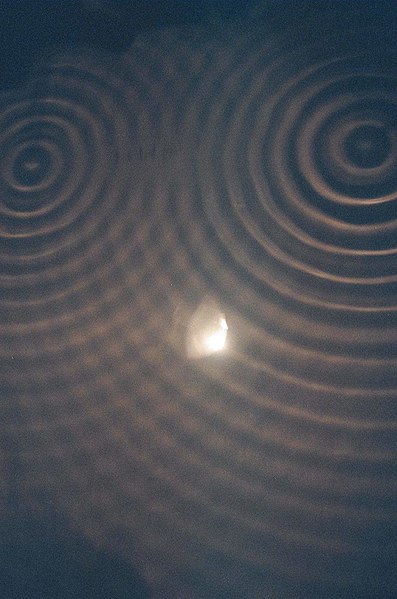
Obviously I am a total layman when it comes to this stuff, but I always wondered in the double slit experiment how do they know that the photons don't just bounce off the edges of the slits as opposed to acting as a wave?
Because the photons set up interference patterns, as opposed to having a an appearance of a spray.