What's new

Do you think its possible we are living in a holographic universe?

Maybe things have changed since I last read about it, but I believe many worlds says that when a choice is made, BOTH outcomes happen. One in our universe, and one in an alternate universe that spins off from us. Thus there ARE no real choices, there is only the randomness of which universe we happen to end up in.


No, just the opposite. I'm saying the criminal did NOT commit the crime in all possible universes. So, if a criminal only committed the crime in our universe because of the randomness of which universe we happen to be in, and didn't commit it in an alternate universe, then how is it just to punish him for that act?

Let's say free will is a real phenomenon with a rational materialist explanation, how does mainstream QM explain it? How exactly does that random and probabilistic nature of particles lend support to the idea that you're making specific and controlled choices? Are you saying that you take comfort in the fact mainstream QM forgoes explanation, thus giving you hope of that free will can be hiding in the mist of the unknown? Come on now. Or do you believe that free choice is immaterial and mystical? In that case, I don't see why MWI would challenge that perspective.

Free will actually works better in the multiverse. Every time you make a choice, other versions make the same or different choices. You choose to go with strawberry ice-cream, other versions of you go with chocolate, others pick strawberry as well, and some decide they don't need the calories. The choices don't have to occur with equal probability, which means a sort of selection will go on. Those who make the better choice will reap the rewards of such choice, and those who don't won't. Each good choice will put you in a better position to make another good choice in the future, increasing the stacks of you that made good choices. Taking an individual and looking at all the choices that unfolded throughout their lives, there will be timelines where the individual did well and lived a rich and productive life, and others where the choices had a negative effect on his well-being. So you can look at the "good" timeline and define those choice as the right ones! And since wavefunction decoherence in MWI is not random, we have a good objective definition of free will, which is something interpretation-free QM can't accomplish.
 
There is an argument to be made that given the molecular structure of an individual brain, and the differences from other brains, and the differences in environment and situation that each brain is placed in, that every choice is determinable if you could perfectly understand all variables associated with thought, both biological and environmental. In other words, I think you could make an argument that free will really does not exist and is merely the output of a very very complex program running on hyper-complex computational equipment, and if you could understand all those variables you could within a very tight tolerance predict future decisions that an individual would make.
 
There is an argument to be made that given the molecular structure of an individual brain, and the differences from other brains, and the differences in environment and situation that each brain is placed in, that every choice is determinable if you could perfectly understand all variables associated with thought, both biological and environmental. In other words, I think you could make an argument that free will really does not exist and is merely the output of a very very complex program running on hyper-complex computational equipment, and if you could understand all those variables you could within a very tight tolerance predict future decisions that an individual would make.

That is very reasonable, and I have no problem with that. But none of it relates to which QM interpretation is best, like I've been saying. What you describe is precisely how I see free will, a practical construct that is the product of the incredible complexity of the human brain, and the numerous environmental variables that affects its evolution. Nothing is "free". It just looks that way.
 
There is an argument to be made that given the molecular structure of an individual brain, and the differences from other brains, and the differences in environment and situation that each brain is placed in, that every choice is determinable if you could perfectly understand all variables associated with thought, both biological and environmental. In other words, I think you could make an argument that free will really does not exist and is merely the output of a very very complex program running on hyper-complex computational equipment, and if you could understand all those variables you could within a very tight tolerance predict future decisions that an individual would make.

Ive read about a few studies, and seen a couple on video of evidence that suggests that our brains know whats coming before it materializes. Such as, a test where lights were used and the subject just had to signal with the push of a button which light lit up. The tests showed that the brain would signal its choice before the picture was even shown. Its been a while since I have read about it so the details my be a little off.

Not sure how credible the tests were, but never the less, someone was claiming. So It would lend support to what you are saying.
 
Hey Siro and Colton, what do you guys think about the quantum eraser experiment, and what does it say about the observer role?

You both seem to know a lot about this. Curious what you think about it.
 
Or do you believe that free choice is immaterial and mystical?

I guess I don't see free will as explainable through the laws of physics, so I guess in that sense you could call it mystical. I don't believe that however well you could accurately describe a person's brain's state, that you could predict his or her choices through probabilistic methods only.

Free will actually works better in the multiverse. Every time you make a choice, other versions make the same or different choices. You choose to go with strawberry ice-cream, other versions of you go with chocolate, others pick strawberry as well, and some decide they don't need the calories. The choices don't have to occur with equal probability, which means a sort of selection will go on. Those who make the better choice will reap the rewards of such choice, and those who don't won't. Each good choice will put you in a better position to make another good choice in the future, increasing the stacks of you that made good choices. Taking an individual and looking at all the choices that unfolded throughout their lives, there will be timelines where the individual did well and lived a rich and productive life, and others where the choices had a negative effect on his well-being. So you can look at the "good" timeline and define those choice as the right ones! And since wavefunction decoherence in MWI is not random, we have a good objective definition of free will, which is something interpretation-free QM can't accomplish.

If other versions of you exist that made other choices, then there is no free will. There is only the coincidence of being in the universe where that particular choice was made. I see this as being similar to the anthropic principle, if that helps. A type of observational bias.

If I read what you are saying correctly, you're talking about continued good choices leading towards a greater likelihood of good choices in the future. But I don't see how that's possible because there will be just as many universes (in some sense) where you made bad choices as there are where you made good choices. So why wouldn't your same argument work in reverse?
 
Hey Siro and Colton, what do you guys think about the quantum eraser experiment, and what does it say about the observer role?

You both seem to know a lot about this. Curious what you think about it.

That wasn't a phrase I was familiar with, so I googled it to find this article: https://en.wikipedia.org/wiki/Quantum_eraser_experiment

I've heard of that before, but not in enough detail to know whether the Wikipedia article is accurate. Reading that article myself just now, it seems rather like quantum teleportation, where the measurement of one part of an entangled pair causes the wavefunction to collapse and the state of the other part to become definite. To really understand it, though, I'd have to read the Physical Review A paper that has the technical details (external link at the bottom of the Wikipedia article). I don't have time to do that in detail right now, but the funny thing is that a quick glance over the paper makes it seem like I actually have all of the equipment needed to do the experiment in my lab. :-) Would take a while to set it up, though.

But what's your specific question about it? Do I believe it? Do I think it's cool? Do I think it says anything about humanity? Or what?
 
Last edited:
Obviously I am a total layman when it comes to this stuff, but I always wondered in the double slit experiment how do they know that the photons don't just bounce off the edges of the slits as opposed to acting as a wave?
 
Obviously I am a total layman when it comes to this stuff, but I always wondered in the double slit experiment how do they know that the photons don't just bounce off the edges of the slits as opposed to acting as a wave?

Because the photons set up interference patterns, as opposed to having a an appearance of a spray.
 
Because the photons set up interference patterns, as opposed to having a an appearance of a spray.

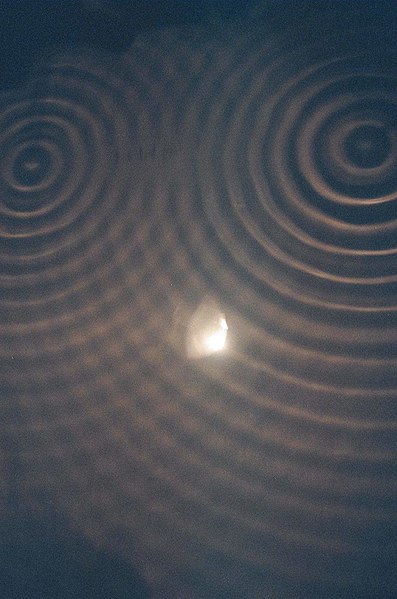
And even more specifically, because the interference patterns that get set up (aka diffraction patterns) are exactly as predicted by wave physics, and are just like the patterns produced by other waves. See example the pictures of water waves at this Wikipedia article: https://en.wikipedia.org/wiki/Ripple_tank

Here's the last photo from that article:

397px-Two-point-interference-ripple-tank.JPG


That's just the same as the pattern you get when light passes through two nearby slits. Think of the light as traveling from top to bottom, and the middles of the two sets of circles would be the positions of the slits. You could put a light detector anywhere in the bottom two thirds of the region (i.e. past the slits), and detect the same alternating patches of light and dark that show up in these water waves. The scale would just be smaller, of course.
 
Coincidentally, I just did a demonstration of that type of interference in my class yesterday, using sound waves coming from two speakers.

Here's a video of the demo (recorded a few years ago):
https://www.youtube.com/watch?v=g4skBirEdBk

It's not the greatest video, but you can kind of hear how the audio volume goes up and down as the camera moves around. (It's easier to hear in person.) That's from the camera hitting loud and soft areas in the room as it moves side to side, not from any change in the audio source.

I also created this animation to represent what was going on. The two speakers are the sources of the waves, the two things going up and down next to each other at the top.

combined.gif


You can see that for a given row in the classroom, if you move your head back and forth to the left and right you will hit regions of loud (big amplitude waves) and soft (small amplitude waves). Same thing happens with light, except "loud" = "bright" and "soft" = "dark".

Probably more info than you wanted...
 
Back
Top