What's new

My argument for the death penalty...

Heh, the "whole range," eh? Nowhere has it been claimed that a guy could possibly maintain consciousness, without passin out due to lack of blood pressure, for the entire time it takes for the brain to utterly die, chemically-speakin. In fact, the medical authorities I have cited explicitly say otherwise. They said "two seconds at most," if I remember rightly. The second cite merely says:

"If that [loss of consciousness] weren't to happen immediately, an individual could in theory remain self-aware for part of the thirteen-second period."

Hint: "Part of" aint the whole, get it?

Are you ready to be really really embarassed? This is why you actually need to track down full articles instead of relying solely on summaries on about.com and wiki.

Here's a longer version of the quote from Ron Wright in Cabinet Magazine.

The evidence for the survival of awareness (as opposed to brain activity) after decapitation remains inconclusive. According to Dr. Ron Wright, a forensic pathologist and former chief medical examiner of Broward County Florida, "After your head is cut off by a guillotine, you have 13 seconds of consciousness (+/- 1 or 2). [...] The 13 seconds is the amount of high energy phosphates that the cytochromes in the brain have to keep going without new oxygen and glucose."4 Naturally, electrochemical activity is no guarantor of conscious thought, although as Wright notes, there are alleged instances of disembodied heads blinking in response to questions, "two for yes and one for no."

https://www.cabinetmagazine.org/issues/10/severed_head.php

Again, I would emphasize that the original source for this quote, the urban legends web page no longer exists, but that explicitly contradicts your intepretation of your "medical authorities." It provides a range, and acknowledges explicitly that there is a difference between electrochemical activity and concious thought while stating the evidence is "inconclusive." Your source also acknowledges that there are reported instances that run counter to the 13-second and instant loss of conciousness hypothesis.

I'm sure you will have some reason why we're absolutely certain, but at this point you're just trolling anyway.
 
You guys understand that the execution that is going to take place will be by firing squad, not guillotine, right?

And Hopper, wouldn't it be easier if you just wrote in plain English? BTW I +rep you every chance I get.
 
BTW I +rep you every chance I get.

Well, thanks, I guess, eh, Game? I'm actually lookin for -reps, truth be told, but thanks for the sentiments, anywaze.

You would be more better off to keep them to your own damn self, though, I spect. Ya don't wanna go runnin counter to any of the mods here, like Kicky, for example, who just declared that I am "one of the most despised posters." I spect he's takin names, right now, see?
 
Are you ready to be really really embarassed? This is why you actually need to track down full articles instead of relying solely on summaries on about.com and wiki.

What point is it that you think you're makin here, eh, Kicky? This article clearly says that: "Naturally, electrochemical activity is no guarantor of conscious thought, although as Wright notes, there are alleged instances of disembodied heads blinking in response to questions, "two for yes and one for no."

Furthermore, there are two footnotes to this excerpt (4 and 5). If you look at those footnotes, it says: "Quoted in Robert Wilde, "Does The Head Of A Guillotined Individual Remain Briefly Alive?," 2001, available here. The Wright quote appears in full here."

This happens to be the very article I started with! Click on the footnote where it says "here" and it will take you straight to the cite I gave to begin with.

If the author of this article is merely quoting from my article, he has both misquoted and misunderstood it.

Edit: Well, it says "here" in two places, I guess. One takes you to my cite, the other says it can't be displayed.
 
Well, thanks, I guess, eh, Game? I'm actually lookin for -reps, truth be told, but thanks for the sentiments, anywaze.

You would be more better off to keep them to your own damn self, though, I spect. Ya don't wanna go runnin counter to any of the mods here, like Kicky, for example, who just declared that I am "one of the most despised posters." I spect he's takin names, right now, see?

I know you're lookin' for neg rep, that's the point.
 
What point is it that you think you're makin here, eh, Kicky? This article clearly says that: "Naturally, electrochemical activity is no guarantor of conscious thought, although as Wright notes, there are alleged instances of disembodied heads blinking in response to questions, "two for yes and one for no."

Furthermore, there are two footnotes to this excerpt (4 and 5). If you look at those footnotes, it says: "Quoted in Robert Wilde, "Does The Head Of A Guillotined Individual Remain Briefly Alive?," 2001, available here. The Wright quote appears in full here."

This happens to be the very article I started with! Click on the footnote where it says "here" and it will take you straight to the cite I gave to begin with.

If the author of this article is merely quoting from my article, he has both misquoted and misunderstood it.

No. The fourth and fifth footnotes "in full" link goes to the same urbanlegends webpage your about.com cites from. (Click the last word in the cite). I explicitly stated, in the same post, "Again, I would emphasize that the original source for this quote, the urban legends web page no longer exists."

Trying to source your quote leads in a big circle. I searched several places using a variety of google sources all of which seem to result in the same article that no longer exists and some of the links being in articles that are as much as 13 years old. However, those that quote from the source are pretty clearly acknowledging that a) there's a range, b) he's talking about conciousness, and c) that the numbers are up for debate. Some quote him in context with others who give ranges between five and twenty seconds.

I'm well aware you'll reply until we reach 45 pages, so at this point I feel pretty comfortable saying anyone that wants to look at the sources and think about the arguments can make up their own mind. We've reached the limits of my interest. Feel free to continue replying to yourself ad infinitum as is your general habit.
 
No, Kicky, I don't want to prolong this either, but I will respond to your supposed "parting shot."

1. If the full article is not available, then I guess we can't read it, but I didn't quote this Wright guy as a medical authority of the topic of consciousness anyway (I was refering to the wiki cite of a british medical journal). I did quote the about.com author, but not as a "medical authority."

2. I really don't care about matters of seconds, but here's another claim about the nature of consciousness when blood is no longer bein pumped: "A gunshot to the head or heart or the sudden fracture of the neck with spinal cord damage or transection (cutting in half) as occurs in hanging or severe accidents are events associated with instantaneous death.There is an adage in cardiology that says if the heart suddenly stops, loss of consciousness will occur in 4 seconds if standing, 8 if sitting, and 12 if lying down."

This same article goes on to ask: "Did Marie and Louie die instantly or did they have a few seconds of reflection?...Was Languille alive for those few seconds or were these movements simply neurological reflexes? Such reflexes are not uncommon and are simply the nerves firing and causing muscular activity. They do not require any stimulus from the brain so can occur after death. Whether Languille lived a few seconds or whether these were normal reflexes will never be known but it is intriguing." https://writersforensicsblog.wordpress.com/2009/09/07/guillotine-and-death-how-long-does-it-take/ The author here does not appear to be a physician

3. Our dispute was not over a matter of "a few seconds" to begin with. I simply pointed out that if you wanted to quote wiki fairly, you coulda included the claim from the british medical journal cited there, claiming "at most two seconds," or sumthin like that. You took exception to that by way of trying to claim that medical/anatomical knowledge was "speculation."
 
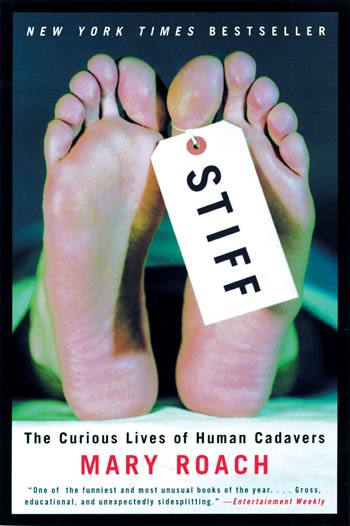
aint hoppin and kicky, have either of you read this book? if not, I strongly suggest you do so - - it might help you get to the bottom of some of these questions you're asking

Stiff-cover.jpg


These two chapters in particular might be of particular relevance to your discussion:
# How to Know if You're Dead: Beating-heart cadavers, live burial, and the scientific search for the soul

# Just a Head: Decapitation, reanimation, and the human head transplant
 
aint hoppin and kicky, have either of you read this book? if not, I strongly suggest you do so - - it might help you get to the bottom of some of these questions you're asking


These two chapters in particular might be of particular relevance to your discussion:

Mo, ya already knowz I caint read so good, eh? Just tell us what is sez, kay?
 
I have not read this whole thread but isnt it true that there cannot be a death penalty without a confession or DNA evidence? That guarentees no innocent people will be put to death.
 
I have not read this whole thread but isnt it true that there cannot be a death penalty without a confession or DNA evidence? That guarentees no innocent people will be put to death.

Those are not the facts. To put it simply, the only guarantees are that innocent people have been put to death. There are more guarantees that innocent people who were on death row were released when evidence came to light that exonerated them. Just relating to DNA, there have been 254 people who have been exonerated on that evidence alone (though not necessarily death penalty crimes) since 1989. Of those people, 25 percent gave false confessions. 17 of the 254 served time on Death Row, or an average about one a year since DNA started being used for exculpatory purposes in appeals.

I'm just plucking facts from The Innocence Project (innocenceproject.org). There are countless other organizations who work the same fields they do. In total, 138 people have been freed from Death Row since 1973. So if you can live with the idea that almost 4 people a year would have been put to death who were innocent of their crimes, then the Death Penalty is a really great idea.
 
Back
Top