Appeal to authority is lame and you are being closed minded. I’m guessing you haven’t read Paul Krugman’s “What Economists (Including Me) Got Wrong About Globalization” essay, anything from Lionel Gilbert prize winner, Bloomberg’s fifty most influential list, and highly, highly respected by fellow economists Michael Pettis, the study linked in the NPR article above or any other works by the authors, or have a clue on how much economists have gotten dead wrong over the decades. Being wrong is par the course for that profession, even including Nobel Prize winners. Probably the most influential economist of the last 50 years, Nobel Prize winner Milton Friedman’s work on monetarism has been all but discarded. Much of Eugene Fama’s work has been shown to have little to no value. Hell, the Taylor Rule, Phillips Curve, everything we still rely upon for central banking theory is somewhere between highly questioned to almost discarded.
Besides, none of these unnamed Nobel Prize Winners disagree with me.
Lots of sources for ya:
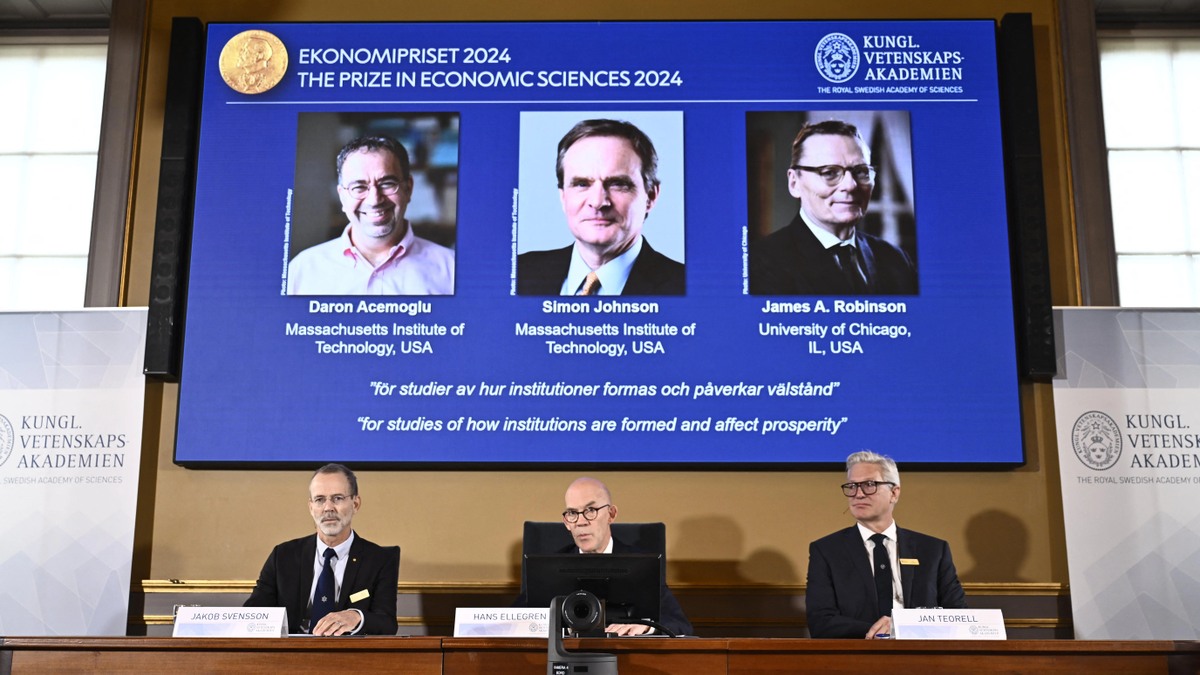
Simon Johnson, a co-winner of the 2024 Nobel Prize in Economics, spoke with Quartz before Election Day

qz.com
23 Nobel Prize-winning economists have endorsed Kamala Harris for president, arguing her policies will enhance economic growth and equity. They criticize Donald Trump's proposals, highlighting issues like interference with the Federal Reserve, statistical agencies, excessive tariffs, mass...

economictimes.indiatimes.com
A bit from just one of those sources: Economists mostly shun politics in favor of policy. We prefer to be aloof soothsayers giving voice to data and research rather than our own beliefs. A luminary in the profession once told me that “the only political party economists support is whichever is willing to be smart,” before adding, “and a smart economist would never join a political party.” And yet, in a stunning turn — at least for us in the profession — 23 Nobel Prize-winning economists, from Columbia University professor Joseph Stiglitz to Massachusetts Institute of Technology’s Daron Acemoglu, released a letter endorsing
Kamala Harris for US president.
“Simply put, Harris’s policies will result in a stronger economic performance, with economic growth that is more robust, more sustainable, and more equitable,” the
Nobel laureates wrote in the letter. Donald Trump’s policies, they added, would “lead to higher prices, larger deficits, and greater inequality.” As for Harris, they wrote that she “has emphasized policies that strengthen the middle class, enhance competition, and promote entrepreneurship. On issue after issue, Harris’s economic agenda will do far more than Donald Trump’s to increase the economic strength and well-being of our nation and its people.”
Individuals can struggle to sort out the nuance of their own economic experience over the past eight years in weighing Harris versus Trump, but professional economists of all stripes have little to be torn about. It’s not a toss-up: Trump’s policy agenda gives much for economists to condemn. Any one of these policies on their own would be enough to disqualify a candidate, but that Trump has proposed them all is a clear enough indicator of just how much the economy would be at risk if he were reelected.
Interfering in the Federal Reserve. Trump and his running mate, Ohio Senator JD Vance, have proposed ending the Fed’s independence and giving the president a say in such monetary policy as setting interest rates. Central bank independence is a foundational component of stable economies. Researchers have found a clear, causal relationship: the more independent the central bank, the lower the rates of inflation. Even when examining just the US, political pressure from the president raises prices.
Interfering in statistical agencies. The Trump administration interfered in the 2020 census by ending the count early and pressuring bureaucrats at the Census Bureau to change their methodology. Those workers, protected civil servants, resisted, as emails revealed by Freedom of Information Act requests show. But Trump has proposed replacing many civil servants with political appointees through Schedule F, a tactic he tried at the end of his presidency, and Republicans are already attacking the Bureau of Labor Statistics. At stake is the reliable reporting of economic data.
Excessive tariffs. Trump has advocated for a 20% import tax on all goods from all countries, but higher rates for China and cars from Mexico. The tariffs from Trump’s time in office are a good proving ground. Economists universally agree that tariffs increase prices for consumers because it’s domestic companies that are importing the goods that pay the tariffs and then attempt to pass those costs to consumers. As a result, tariffs have proven to shave growth off GDP.
The larger and broader tariffs are, the higher the prices for US consumers. History and the Smoot-Hawley Tariff Act provide another warning: The most likely outcome would be retaliation against US exporters by our trade partners.
Mass deportation. Trump has promised the largest deportation in the history of the US, and Republicans rallied at their convention this summer by waiving signs that read “Mass Deportation Now!” Researchers at the center-left Brookings Institution estimate that more immigration than expected has been a windfall for the economy, propping up consumer demand and job growth. Further, deportation would hurt US-born workers, affecting critical industries such as child care and construction where immigrants
are employed and lowering aggregate demand.
Wider budget deficits. The federal government is running trillion-dollar deficits and the nonpartisan and nonprofit Committee for a Responsible Federal Budget determined that Trump’s policy proposals are twice as expensive as those from Harris. The vice president proposes less new spending than Trump and wants increases in tax revenue to pay for spending, which Trump does not. Additional pressure on fiscal health comes from Social Security, which doesn’t directly add to the deficit but Congress does owe the program a few trillion dollars, currently held in a trust fund. The Committee for a Responsible Federal Budget found that Trump’s Social Security proposals would cause the program’s shortfall to swell by an additional $2 trillion and deplete the trust fund three years sooner than is currently projected in 2035.
In their letter, the Nobel laureates stressed the importance of the rule of law, economic certainty and political certainty, which they said are “among the most important determinants of economic success.” The fact that many of the CEOs who are making parlays to Trump are doing so out of concern for his open plans of retribution for enemies only proves the point of these high-minded economists.