
You are using an out of date browser. It may not display this or other websites correctly.
You should upgrade or use an alternative browser.
You should upgrade or use an alternative browser.
Obama Government Shutdown?
- Thread starter ema
- Start date


The votes tell a different story.
The public does not currently want the ACA as indicated by the polls and giving the house to republicans that ran on repealing Obamacare.
So this leaves us divided. The only way forward is compromise. Any side that won't budge is to blame. Neither will so they share the fault.
The GOP gerrymandered their way into the house. Kudos for them I guess, but it's hardly some mandate from all of the people in this country, or even the majority.
For example, Colorado has 7 Congressional districts, and the GOP has a majority of the districts (with 4). Even though the state has a Dem Governor, voted for Obama twice, and has two Dem Senators. However, since the districts are split in a way that has 3 of them in quite safe conservative districts and two in quite safe liberal districts, the GOP has the one advantage in house spots (the other two are battlegrounds for the most part).
Also in 2012, Dems received 1.2 million more votes for their reps in the house, yet the GOP controls more seats. I get that's the way it is, and I actually don't have a problem with the house system in general since each region needs their own representation, but again I won't buy that this is what the people of this country want.
So of course some GOP hardliner is going to hold things up, because if they live in a safe district than who cares...there won't be any political blowback on them.
Last edited:
All I know is that every time taxes go up it seems like the middle class (which I will probably always be part of) take the brunt of it. And it seems like democrats push to help every group that can't help themselves. Including giving Social security to people who have never paid into it. I disagree with the republicans seemingly non stop effort to cut taxes for the rich. I can't stand that they don't seem to think the rich should pay their fair share. But at least they don't seem to give the money to everybody. I'm not against my taxes going to help the poor. I disagree with the concept that giving it to them for free is the answer. At least make those people getting assistance earn it in some way.
My tenant is pretty poor (she makes a whopping $8 an hour) and is struggling hard right now. Any advice on how to give her some of that money you're giving away? God knows I've tried yet she keeps getting denied for making too much money.

Gerrymandered my butt. They won it in response to the democratic control. People didn't want a mandate.
The house districts were absolutely gerrymandered Stoked. This is one of those indisputable truths.
I posted this for you earlier but I'll do so again. This is an analysis of the 2012 election results from Princeton done shortly after the fact.
https://election.princeton.edu/2012/11/09/the-new-house-with-less-democracy/
Today, Speaker John Boehner stated that his party’s leverage comes from the fact that it retained control of the House. Yet they lost the popular vote. How can this be?
Before the election, I predicted that even if more people voted for Democratic House candidates, Republicans could still retain control. The reason I gave was redistricting since 2010, which has tilted the playing field significantly. The prediction was correct – though if anything, I underestimated the effect.
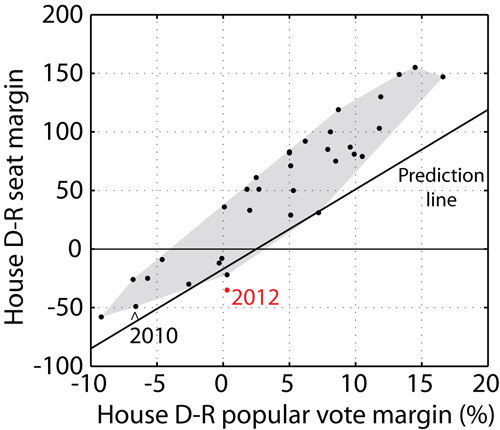
I estimated that Democrats would have to win the national popular vote by 2.5% in order to have a 50-50 chance of gaining control. I also predicted that the House popular vote margin would be D+0.0%, for Democratic gains of 2-22 seats . As of now, counting the leader in each undecided race, the new House will be 235 R, 200 D, a gain of only 7 seats. ThinkProgress reports a popular-vote tally of 50.3% D to 49.7%, a margin of D+0.6%. Both results are within range of my prediction.
However, this is quite notable. The popular vote was a swing of more than 6% from the 2010 election, which was 53.5% R, 46.5% D. Yet the composition of the House hardly changed – and the party that got more votes is not in control. This discrepancy between popular votes and seat counts is the largest since 1950.
Did I underestimate the tilt of the playing field? Based on how far the red data point is from the black prediction line, the “structural unfairness” may be higher – as much as 5% of the popular vote. That is incredible. Clearly nonpartisan redistricting reform would be in our democracy’s best interests.
Incidentally, some readers have suggested to me a reform in the Electoral College so that each Congressional district votes for its elector directly. As you can see, such a rule change would allow redistricting to influence the fairness of the Electoral College. Winner-take-all state races occasionally cause a problem, but which party gains is somewhat variable. It seems that there are worse things than the status quo.
The bolded part is particularly important. This is the most gerrymandered congress in our lifetime.

The GOP gerrymandered their way into the house. Kudos for them I guess, but it's hardly some mandate from all of the people in this country, or even the majority.
For example, Colorado has 7 Congressional districts, and the GOP has a majority of the districts (with 4). Even though the state has a Dem Governor, voted for Obama twice, and has two Dem Senators. However, since the districts are split in a way that has 3 of them in quite safe conservative districts and two in quite safe liberal districts, the GOP has the one advantage in house spots (the other two are battlegrounds for the most part).
Also in 2012, Dems received 1.2 million more votes for their reps in the house, yet the GOP controls more seats. I get that's the way it is, and I actually don't have a problem with the house system in general since each region needs their own representation, but again I won't buy that this is what the people of this country want.
So of course some GOP hardliner is going to hold things up, because if they live in a safe district than who cares...there won't be any political blowback on them.
I am in no way saying that the GOP has a mandate. They are even farther from it than the Dems. But the fact still remains that in 2010 the reublicans gained:
63 seats in the house. That is the highest loss by a party in the house in a midterm election since 1938.
They gained the governers seat in 6 states to have a total of 29 out of 50. Some of them in left leaning states like Maine, New Mexico, Wisconsin and Pennsylvania
They picked up 6 Senate seats.
The gained a majority of the state legislative bodies. 27 are reps, 17 are dems, 5 are split and 1 is "non partisan"
2010 was a resounding defeat for the dems and clearly showed a divided America as dems maintained the Senate and won the presidency in 2012, again.
Elections do matter but it works both ways. Stop trying to pretend it only does for one side.
The house districts were absolutely gerrymandered Stoked. This is one of those indisputable truths.
I posted this for you earlier but I'll do so again. This is an analysis of the 2012 election results from Princeton done shortly after the fact.
https://election.princeton.edu/2012/11/09/the-new-house-with-less-democracy/
The bolded part is particularly important. This is the most gerrymandered congress in our lifetime.
Redistricting since 2010...
Is one party redistricting to better help themselves? Of course they are. The parties always do that. It is just being abused even harder now. Yet another obvious problem with the system.
But again I was talking about 2010 gains.
Edit: Does anyone know what it takes to redistrict on state and national levels? I do not think that it should be rigged to support the party in power. How can it be fixed? Requiring a super majority maybe?
Last edited:

framer
Well-Known Member
The Civil Rights Act is the genesis behind much if not most of the gerrymandering. You group together enough idiots out of a larger area that will vote for a lackwit like Maxine Waxine Waters, don't be surprised when the surrounding districts start leaning a little more conservative. I think your bigger issue is that once someone gets elected to the House there is a greater than 90% retention across the board. There are many, many advantages to being an incumbent that makes you hard to unseat. It's much easier to buy votes when you are in power.

LogGrad98
Well-Known Member
Contributor
20-21 Award Winner
2022 Award Winner
2023 Award Winner
2024 Award Winner
I find it scary how many on here seem to think the best case scenario would be a single party system. As flawed as it is, and as big a mess as the republican party is right now, the dissenting voice still needs to be heard. Checks and balances can't happen when the entire country is run by group think. It may sound like hyperbole but EVERY single dictatorship started by eliminating any competing parties. That is a big part of how Rome fell. An emperor is put in power at a time of crisis and refused to let that power go. Is that what you really want? Total freedom to dictate? Scares the ever living **** out of me.
Sent from my SAMSUNG-SGH-I957 using JazzFanz mobile app
Sent from my SAMSUNG-SGH-I957 using JazzFanz mobile app

I'm gonna assume that people much earlier in the thread were discussing single party systems and you weren't suggesting that peeps supported one just because they thought this government hostage taking is inappropriate.
The attacks on one party or another were on here long before the shutdown. There are some that blindly support on party over the other. I think both parties stink but having them both helps them restrain each other.
Yeah I'm not sure anyone here on either side at least since I've been involved in this convo is pushing a one party system
I have not seen people actively pushing for a 1 party system. But when you blindly support one side over the other is there really any difference?