What's new

The Caravan

Do we know it's illegally? I feel like we can't know until they get to a port of entry to officially request asylum. There's nuances, but they should be legally allowed to apply. I just don't buy that all 4,000 fleeing are criminals.

https://www.americanimmigrationcouncil.org/research/asylum-united-states

So 5,000 troops, on top of what we've got on border patrol already. Seems excessive. But perhaps our commander in chief is sending them down to help process applications, and not something like open fire on largely civilians that are already running for their lives.

Right?
I would he absolutely shocked if there's any actual bloodshed as a result of this. I think it's largely performative. Trump created a lot of fear about this caravan and now is trying to look tough and in control by committing troops. This is about optics going into the midterms, nothing else.
 
I would he absolutely shocked if there's any actual bloodshed as a result of this. I think it's largely performative. Trump created a lot of fear about this caravan and now is trying to look tough and in control by committing troops. This is about optics going into the midterms, nothing else.

It's highly unlikely. It's a posturing move. I get it. And if there was an order to open fire on civilians en masse, would our troops even do it?

I dunno. But I'd prefer not finding out.
 
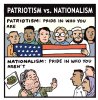
It's probably a bit more complicated than this little cartoon, but to me the difference has been that Nationionalists are proud of their nation in the way it represents the interests of a particular identity. In the US they tend to be White Nationalists, but there are Black Nationalism movements in the US as well.
 
Last edited:

That's whackadoodle stuff.

Words mean what we mean when we say them. For most folks, "patriotism" is an excessive pride bordering on believing you're better than folks in other countries. It's more educated meaning refers to features of your governmental system that can be argued as morally better, or better in principle.

An American Patriot even today is often someone who believes the principles of limited government and stated inviolable human rights is better than, oh, say Xi or Putin one-man rule.

A nationalist, like Trump, might be someone who believes a particular one man is a better representative of national interests than another.... say, like Trump might say.... a Hillary or Obama who is more focused on globalism agenda visions than the interests of our particular citizenry.

But in fact, Trump's idea of America is on the line of the Patriotism I described above. He does have a few notions of rebalancing power towards the people as envisioned in our Constitution, but he is far from a principled Constitutionalist. More like just practical and just wanting business to be more efficient and profitable.
 
https://amp.usatoday.com/amp/1805864002

Pentagon is sending 5,000 troops to the border to stop the caravan.

I heard it run out on Brietbart, which has perhaps the best journalists on the subject, that Trump might work with the Mexican President to set up a camp inside Mexico and take the applications for amnesty there. This would avoid becoming subject to the bad US law that requires release into the interior with little hope they'll appear on their court hearings.

Trump would make it a good deal for Mexico, and the camp would be something like a joint consulate, not US territory. I believe Trump would incentivize Mexican participation in resolving the issues.
 
I don't see the difference betweem those two things. That's like saying white pride is okay, but white supremacy is not. These are just semantics. Word play. Not real philosophical differences. Patriotism is simply nicer sounding word than nationalism. Not substantively different.

From Merriam-Webster:

Definition of patriotism
: love for or devotion to one's country "Although poles apart ideologically, they are both unashamed of their patriotism."— Christopher Hemphill


Definition of nationalism
loyalty and devotion to a nation especially : a sense of national consciousness exalting one nation above all others and placing primary emphasis on promotion of its culture and interests as opposed to those of other nations or supranational groups "Intense nationalism was one of the causes of the war."

Nationalism adds a sense of superiority and exceptionalism to patriotism.
 
I don't see the difference betweem those two things. That's like saying white pride is okay, but white supremacy is not. These are just semantics. Word play. Not real philosophical differences. Patriotism is simply nicer sounding word than nationalism. Not substantively different.

I'm relying on Timothy Snyder a great deal lately. I guess he provides me with meditations of a sort....

“The president is a nationalist, which is not at all the same thing as a patriot. A nationalist encourages us to be our worst, and then tells us that we are the best. A nationalist, “although endlessly brooding on power, victory, defeat, revenge,” wrote Orwell, tends to be “uninterested in what happens in the real world.” Nationalism is relativist, since the only truth is the resentment we feel when we contemplate others. As the novelist Danilo Kiš put it, nationalism “has no universal values, aesthetic or ethical.” A patriot, by contrast, wants the nation to live up to its ideals, which means asking us to be our best selves. A patriot must be concerned with the real world, which is the only place where his country can be loved and sustained. A patriot has universal values, standards by which he judges his nation, always wishing it well—and wishing that it would do better. Democracy failed in Europe in the 1920s, ’30s, and ’40s, and it is failing not only in much of Europe but in many parts of the world today. It is that history and experience that reveals to us the dark range of our possible futures. A nationalist will say that “it can’t happen here,” which is the first step toward disaster. A patriot says that it could happen here, but that we will stop it."

― Timothy Snyder, On Tyranny: Twenty Lessons from the Twentieth Century


“What is patriotism? Let us begin with what patriotism is not. It is not patriotic to dodge the draft and to mock war heroes and their families. It is not patriotic to discriminate against active-duty members of the armed forces in one’s companies, or to campaign to keep disabled veterans away from one’s property. It is not patriotic to compare one’s search for sexual partners in New York with the military service in Vietnam that one has dodged. It is not patriotic to avoid paying taxes, especially when American working families do pay. It is not patriotic to ask those working, taxpaying American families to finance one’s own presidential campaign, and then to spend their contributions in one’s own companies. It is not patriotic to admire foreign dictators. It is not patriotic to cultivate a relationship with Muammar Gaddafi; or to say that Bashar al-Assad and Vladimir Putin are superior leaders. It is not patriotic to call upon Russia to intervene in an American presidential election. It is not patriotic to cite Russian propaganda at rallies. It is not patriotic to share an adviser with Russian oligarchs. It is not patriotic to solicit foreign policy advice from someone who owns shares in a Russian energy company. It is not patriotic to read a foreign policy speech written by someone on the payroll of a Russian energy company. It is not patriotic to appoint a national security adviser who has taken money from a Russian propaganda organ. It is not patriotic to appoint as secretary of state an oilman with Russian financial interests who is the director of a Russian-American energy company and has received the “Order of Friendship” from Putin. The point is not that Russia and America must be enemies. The point is that patriotism involves serving your own country."
― Timothy Snyder, On Tyranny: Twenty Lessons from the Twentieth Century
 
A nationalist, like Trump, might be someone who believes a particular one man is a better representative of national interests than another.... say, like Trump might say.... a Hillary or Obama who is more focused on globalism agenda visions than the interests of our particular citizenry.

Here, Rabbi Rachel Barenblat describes two ways of describing "globalism". One is it's use as a very well known anti-Semitic trope. And one is its use in a manner that holds out hope for a more enlightened humanity. I very much like that latter use of the term. But then I remain idealistic and naive. I actually believe in humanity's higher angels, even when times are darkest.

https://forward.com/scribe/412627/yes-ranting-against-globalism-is-anti-semitic/

Of course, the monster who saw fit to slaughter members of a Jewish congregation a few days ago does not see the world as I do. And even though it would be hard to describe Donald Trump as anti-Semitic, still, the rhetoric he uses, playing to hatred and anger as the consummate demagogue he is, and the rhetoric used by some members of the Republican Party, are clearly understood by those for whom anger and hatred embolden in these dark days:

https://www.washingtonpost.com/opin...403b32-daec-11e8-b3f0-62607289efee_story.html

After a “lone wolf” Islamist militant attack, the media invariably ask: What inspired him to kill? Usually the answer is found in Islamist militant propaganda. We need to ask the same question about right-wing terrorism. What inspired Cesar Sayoc to allegedly send mail bombs to prominent liberals? What inspired Robert Bowers to allegedly gun down 11 people in a Pittsburgh synagogue? What inspired Gregory Bush to allegedly kill two African Americans in Jeffersontown, Ky., after failing to enter a predominantly black church?

To ask these questions in no way obviates the perpetrators’ ultimate responsibility for the evil that they do. But terrorists do not operate in a vacuum. So who created the environment in which right-wing terrorism has become far more commonplace — and, since 9/11, far more deadly — than Islamist terrorism in America?

President Trump — by championing “nationalism,” denouncing “globalists” such as Jewish financier George Soros, vilifying immigrants as “snakes” and “animals,” fearmongering about a refugee caravan and defending white supremacists as “fine people” — bears a substantial share of the blame.

Some of his Republican followers are even more extreme. Rep. Matt Gaetz (R-Fla.) brought a Holocaust denier to the State of the Union and has blamed Soros for financing a Central American immigrant caravan. Rep. Steve King (R-Iowa) gave an interview to a far-right Austrian website in which he endorsed the white-supremacist claim that white nations are committing “slow-motion cultural suicide” by allowing in immigrants of color.

Even GOP leaders are joining in. House Majority Leader Kevin McCarthy (R-Calif.) posted and then deleted a tweet accusing Soros, Michael Bloomberg and Tom Steyer of buying the election. (Soros and Bloomberg are Jewish; Steyer is an Episcopalian whose father was Jewish.) Sen. Charles E. Grassley (R-Iowa), chairman of the Senate Judiciary Committee, blamed Soros for funding protestsagainst then-Supreme Court nominee Brett M. Kavanaugh.

Where do these politicians get these noxious ideas? From a right-wing media industrial machine that includes Fox News, Breitbart, Infowars, Newsmax, the Daily Caller, Gateway Pundit and many other outlets. It was Maria Bartiromo of Fox Business Network who asked Grassley if Soros was behind the Kavanaugh protests — and after Grassley endorsed the charge, Trump gave it his imprimatur. The Wall Street Journal, in turn, ran an op-edendorsing this calumny. Last week, Fox Business host Lou Dobbs interviewed Chris Farrell of Judicial Watch, who claimed that the Central American caravan was directed by the “Soros-occupied State Department,” echoing neo-Nazi propaganda about a “Zionist-occupied government.” (Fox Business has since apologized.)
 
From Merriam-Webster:

Definition of patriotism
: love for or devotion to one's country "Although poles apart ideologically, they are both unashamed of their patriotism."— Christopher Hemphill


Definition of nationalism
loyalty and devotion to a nation especially : a sense of national consciousness exalting one nation above all others and placing primary emphasis on promotion of its culture and interests as opposed to those of other nations or supranational groups "Intense nationalism was one of the causes of the war."

Nationalism adds a sense of superiority and exceptionalism to patriotism.

Thanks Siri. But the difference between "loyalty and devotion" to a country and "love or devotion" to a country is arbitrary. Patriotism is just a more acceptable name for nationalism. If you're a patriot then you're a nationalist. Having pride in who you are is not substantively different from having pride in who you're not.
 
Back
Top